
The Meaning Of Fenrir - Who Is Fenrir?

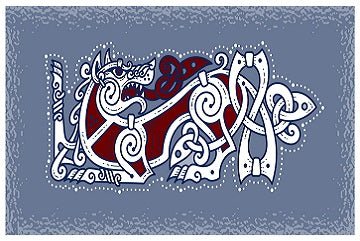
Fenrir is the great wolf of Norse mythology, a son of the trickster god Loki, bound by the gods out of fear, and fated to break free at Ragnarök and swallow Odin himself. His name is usually explained as "fen-dweller," and few figures in Norse myth carry as much dread, or, to modern readers, as much tragedy.
The wolf is often cast as a simple monster. The older sources tell a more unsettling story: the gods feared him because of prophecies before he had done them any harm, and they bound him by a trick and a promise they did not keep. This is the full account of who Fenrir is, where he came from, and why the wolf still means so much to people who wear his image today.
Who Is Fenrir?
Fenrir (Old Norse Fenrir or Fenrisúlfr, "Fenris-wolf") is a monstrous wolf and one of the three children of Loki and the giantess Angrboða. His siblings are Jörmungandr, the serpent who encircles the world, and Hel, who rules the realm of the dead. Almost everything we know of him comes from two 13th-century Icelandic sources: the Poetic Edda, a collection of older anonymous poems, and the Prose Edda of Snorri Sturluson.
The name "Fenrir" is usually explained as "fen-dweller", from the same word as English fen, a marsh, though no medieval source explains it and the etymology is not certain. He has other names too. In the poem Lokasenna the god Týr calls him Hróðrsvitnir, "famous wolf", and in Skáldskaparmál Snorri calls Loki the father of Vánargandr, "that is Fenrisúlfr": the monster of the river Ván, which, as we will see, runs from the wolf's own jaws.
Why the Gods Feared Him
Fenrir's tragedy begins before he has done anything at all. Snorri says the three children were growing up in Jötunheimar when the gods learned from prophecies that great harm would come to them from these siblings, and the prophecies also said that the wolf would one day be the death of Odin. Rather than wait, Odin sent the gods to fetch the children. He threw the serpent into the sea and cast Hel into Niflheim.
The wolf they kept. The gods raised Fenrir at home, and only the war-god Týr was brave enough to go up to him and feed him. But they saw how much he grew every day, and every prophecy said he was destined to harm them, so they resolved to bind him.

The Three Fetters
According to Snorri's Gylfaginning (chapter 34), the gods made a game of it. They brought Fenrir a heavy iron fetter called Læðingr and dared him to test his strength against it. Confident, the wolf let them bind him, and broke it at the first kick. They tried again with Drómi, twice as strong; Fenrir strained harder, but shattered that one too. From this came the Old Norse saying, "to loosen out of Læðingr or to dash out of Drómi", used whenever something is done with great effort.
Gleipnir: A Chain of Impossible Things
Now the gods feared they would never bind the wolf. Odin sent Skírnir, the god Freyr's messenger, down into Svartálfaheimr to certain dwarfs. Dwarfs are the master smiths of the myths: in another story two dwarf brothers forge Thor's hammer. These dwarfs made Gleipnir, a fetter as smooth and soft as a silk ribbon, yet strong and sure, from six things:
- the sound of a cat's footfall
- the beard of a woman
- the roots of a mountain
- the sinews of a bear
- the breath of a fish
- the spittle of a bird
Snorri offers proof that he is not lying: you will have noticed, he says, that a woman has no beard, a running cat makes no sound and a mountain has no roots. The popular idea that these things are missing because the dwarfs used them all up is a modern gloss; Snorri only points out that they cannot be found. So is the thought that a bond made of things that do not exist is one no strength can break, though it is a natural reading of the story.
The Hand of Týr
The gods took the wolf out to an island called Lyngvi in the lake Ámsvartnir and showed him the ribbon. Fenrir was no fool. Eyeing the thin, silken cord, he suspected a trick, for what glory was there in snapping something so slight, and what danger if it were more than it seemed? The gods told him that if he could not break it, he would be no threat to them, and they would set him free. He agreed to be bound only on one condition: that one of the gods place a hand in his mouth as a pledge that this was done without deceit.
The gods looked at one another, and no one moved, except Týr, who laid his right hand in the wolf's mouth. When Fenrir strained, the more he fought, the tighter Gleipnir held. Then all the gods laughed, except Týr: he lost his hand. Earlier in the book Snorri adds that when the gods would not let the wolf go, he bit the hand off at the place now called the "wolf-joint" (úlfliðr), the wrist.

Snorri tells it as the proof of Týr's courage: Týr is the boldest of the gods, with great power over victory in battle, and after this he is one-handed and, Snorri says, "not called a reconciler of men". Modern books often add that he was a god of law and oaths; the Norse texts do not say so. In Lokasenna, Loki taunts him about the right hand Fenrir tore from him, and Týr answers that he may lack a hand, but Loki lacks his wolf, who lies in bonds until Ragnarök. Týr knowingly gave his right hand as the pledge for a promise the gods did not keep. They won, but by breaking their word, and Snorri does not hide it. Read that way, the "monster" keeps to his terms and the gods do not.
Bound Until the End of the World
With Fenrir held fast, the gods took the cord hanging from the fetter, called Gelgja, drew it through a great slab of rock called Gjöll and fastened the slab deep in the earth, then drove a great stone, Þviti, deeper still to anchor it. When the wolf gaped and snapped at them, they thrust a sword into his mouth, its hilt against his lower gums and its point against the roof of his mouth, propping his jaws open. He howls horribly, and the slaver that runs from his mouth is the river called Ván, "hope" or "expectation". There he lies until Ragnarök. Why not simply kill him? Because, Snorri says, the gods held their sanctuaries so sacred that they would not stain them with the wolf's blood, even though the prophecies said he would be the death of Odin.
Fenrir at Ragnarök
That day is Ragnarök, the doom of the gods. When the end comes, Fenrir breaks his bonds at last; in Völuspá the refrain warns that "the fetter will snap and the wolf run free". Snorri, in chapter 51 of Gylfaginning, describes him advancing with his lower jaw against the earth and his upper jaw against the sky; he would open them wider still if there were room, and fire blazes from his eyes and nostrils.
Odin rides first, ahead of the warriors of Valhalla, in a golden helmet and wielding the spear Gungnir, and makes for the wolf. But the prophecy holds: the wolf swallows Odin, and that is his death. The poem Vafþrúðnismál (stanza 53) says the same: "the wolf will swallow the Father of Ages". His victory is brief. Odin's son Víðarr, whom Snorri calls the silent god, steps forward wearing a thick shoe said to be made from every scrap of leather that people have ever trimmed from their own shoes at toe and heel, which is why those scraps should be thrown away by anyone who would help the gods. He plants that foot in Fenrir's lower jaw, seizes the upper with one hand and tears the jaws apart, and that is the wolf's death. Soon after, Surtr flings fire over the earth and burns the whole world. The poems tell the killing in their own ways: in Vafþrúðnismál Víðarr splits the wolf's cold jaws, and in Völuspá (stanza 55) he drives his sword into the heart of "Hveðrungr's son", Hveðrungr being a name usually taken as Loki's.
Fenrir, Sköll and Hati: Clearing Up the Confusion
A claim repeated across the internet is that Fenrir is the wolf who devours the sun. An equally common correction says he is not, and that the job belongs to his sons. The sources do not settle it either way.
In chapter 12 of Gylfaginning, Snorri names two wolves who chase the sky: Sköll ("treachery" or "mockery"), who runs after Sól, the sun, and will catch her, and Hati Hróðvitnisson ("he who hates"), who runs ahead of her and wants to seize the moon. He says they come from an old giantess in the Iron Wood (Járnviðr), east of Midgard, who bears many giant sons in the shape of wolves. When he tells of Ragnarök in chapter 51, "the wolf" swallows the sun and "the other wolf" takes the moon, without names, and the stars vanish from the sky. Only after that does the earth shake and Fenrir break loose.
Vafþrúðnismál (stanzas 46 and 47) gives the sun to Fenrir himself. Odin asks where a sun will come from to light the sky once Fenrir has destroyed this one, and the giant answers that the sun will bear a daughter before Fenrir takes her. Snorri quotes that answer too, near the end of Gylfaginning, so the Prose Edda gives the sun to Sköll in one place and to Fenrir in another.
Are Sköll and Hati Fenrir's sons? No source says so in plain words. In Grímnismál (stanza 39) Hati is Hróðvitnis sonr, "the son of Hróðvitnir", and Hróðvitnir, "famous wolf", is usually read as another name for Fenrir, because Lokasenna calls Fenrir Hróðrsvitnir. Völuspá (stanza 40) also says that the old one in the Iron Wood raised Fenris kindir, "Fenrir's kin". That makes "the sons of Fenrir" a fair reading, but only Hati is called anyone's son, and Sköll is never given a father. If you have ever seen the two wolves flanking a sun-and-moon design, those are Sköll and Hati, and they make one of the most meaningful pairings in all of Norse jewellery.
Two further names muddy the picture. In the same chapter of Gylfaginning that gives the moon to Hati, Snorri also calls the mightiest wolf of that brood Mánagarmr, the "moon-hound", and says it is he who swallows the moon. Garmr is a different beast again: the hound bound before the cave Gnipahellir, whose baying marks each turn of the prophecy in Völuspá. He too breaks loose at the end, and in Snorri's account he and Týr fight and kill one another. Whether these are separate creatures or alternative names for the same ones is an old argument among scholars, and the sources do not settle it.
What Does Fenrir Symbolize Today?
In the Norse sources Fenrir is a destroyer, the wolf whose freedom means the end of the gods, and nothing in them holds him up as a figure to admire. The meanings below are modern. Each has a hook in Snorri's story, though: a wolf the gods feared before he had done anything, bound by a trick, and waiting for his chains to break. That is why the wolf resonates now, and why people choose to wear him.
- Untamed strength. Fenrir is raw power that no chain of "impossible things" can hold forever, a symbol of an inner force that refuses to be caged.
- Defiance of fate. The myths are full of fate: Völuspá foretells both that the wolf will kill Odin and that Víðarr will avenge him. Modern readers see Fenrir as the one who meets that fate head-on. To wear the wolf is to face what's coming without flinching.
- Loyalty and the broken oath. Through Týr's sacrifice, Fenrir's story is also about the price of honour and the cost of betrayal, a reminder to keep your word when the gods themselves would not.
- The outsider. Feared and condemned before he ever earned it, Fenrir speaks to anyone who has been judged before being known.
Fenrir in Modern Culture
The wolf has never really left. He turns up in video games built on Norse myth, in countless tattoos, on metal album covers and as a film monster, and each retelling goes back to the same story: the wolf the gods bound, waiting for his chains to break.
Wear the Wolf
If Fenrir's story speaks to you, these pieces carry it well:

Stainless Steel Fenrir Wolf Twisted Viking Arm Ring
A twisted 316L stainless steel bangle with two facing wolf-head ends, adjustable from 18 to 26 cm, so it can be worn on the wrist or as an arm ring.
A few more wolf favourites:
- Fenrir Rune Necklace, a stainless steel pendant of the great wolf with runic detailing, on a steel chain or a leather cord.
- Massive Wolf Chain with Mjölnir, a handmade 316L stainless steel king's chain with wolf-head tips and a Mjölnir pendant.
Browse the full Norse wolf jewellery collection to find your own. Skål.
Keep exploring: Sköll and Hati, the wolves often called his sons; his sibling Jörmungandr the World Serpent; and the wider cast of Norse mythology creatures.
Fenrir FAQ
How do you pronounce Fenrir?
It is usually said FEN-rir (rhyming roughly with "hen-rear"). The Old Norse Fenrisúlfr is closer to FEN-ris-oolv-r.
Is Fenrir good or evil?
The sources do not judge him in those terms. They treat him as a deadly enemy of the gods, fated to kill Odin, but Snorri also shows the gods binding him by a trick before he had harmed them and breaking their promise to set him free. That is why many modern readers see him as a tragic figure rather than a simple villain.
What is the difference between Fenrir, Sköll and Hati?
Fenrir is the great wolf who kills Odin at Ragnarök. Sköll and Hati are the two wolves who chase the sun and the moon, and Snorri says Sköll will catch the sun. They are often called Fenrir's sons because one poem calls Hati the son of Hróðvitnir, a name for Fenrir, but no source says so outright. The poem Vafþrúðnismál says Fenrir himself will take the sun, so the claim that he never eats it is too neat.
Did Fenrir kill Odin?
Yes. At Ragnarök, Fenrir breaks free and swallows Odin. He is then killed in turn by Odin's son Víðarr, who tears the wolf's jaws apart, or, in Völuspá, drives a sword into his heart.
What does a Fenrir or wolf symbol mean today?
Today the Fenrir wolf is worn as a symbol of untamed strength, loyalty, and the courage to face one's fate without fear. Those meanings are modern; in the Norse sources the wolf is a destroyer. They are why it remains one of the most popular motifs in Viking and Norse jewellery.
Primary sources: the Poetic Edda (Völuspá, Vafþrúðnismál, Grímnismál, Lokasenna) and Snorri Sturluson's Prose Edda (Gylfaginning, Skáldskaparmál); chapter and stanza numbers follow the texts on heimskringla.no linked above; see also the World History Encyclopedia entry on Fenrir.