
What Is The Meaning Of A Viking Hammer Necklace
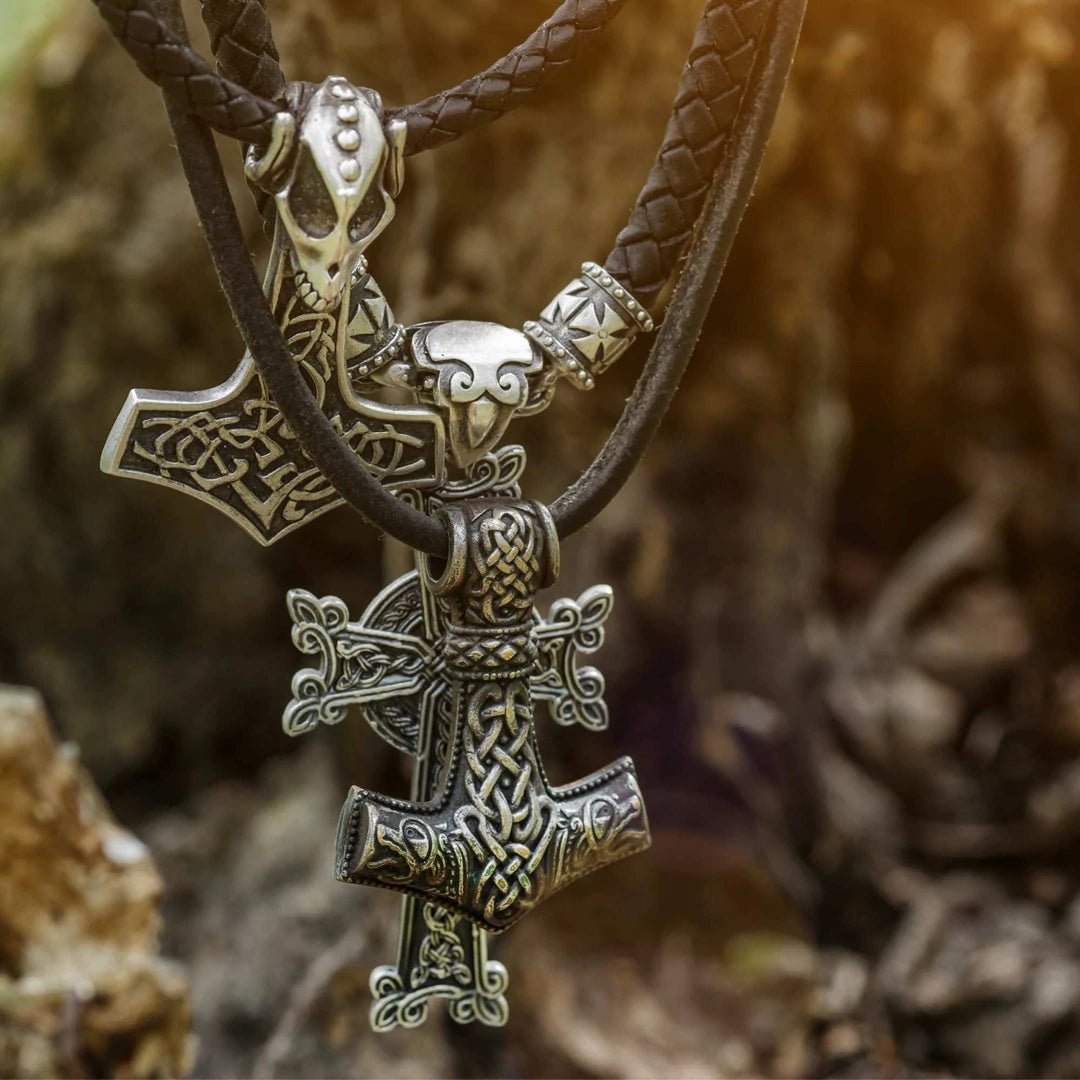
A Viking hammer necklace is a pendant shaped like Mjolnir, the hammer of the Norse god Thor, worn as a symbol of protection, strength and faith. Norse pagans wore Thor's hammer amulets throughout the Viking Age to show their devotion to Thor, and the design is one of the oldest pendants in Scandinavian jewellery, with hammer-shaped amulets appearing in the North as far back as the Bronze Age.
Below we explain what the hammer meant to the Norse, the myths behind Mjolnir, the different pendant styles, and how to choose one today. You can browse the shapes as you read in our Thor's hammer and Viking necklace collections.

Who is Thor, and what is Mjolnir?
Thor is the Norse god of thunder, son of Odin and the earth goddess Jörd. He is pictured as a huge, red-bearded man who rides a chariot pulled by two goats, Tanngnjóstr and Tanngrisnir, and he is tied to storms, strength, protection and fertility. His task was to guard Asgard, the home of the gods, against the giants who threatened it.
Mjolnir was his weapon. The name is often linked to lightning, though it may derive from an older root meaning to crush or grind. The hammer was more than a weapon of war, though. It was used to bless and make sacred: the Norse hallowed weddings, births and funerals with Thor's hammer, and in one myth Thor kills his own goats for a meal, then restores them to life by blessing their bones with Mjolnir. For a deeper look at the god himself, see our guide to Thor, god of thunder.
What a Viking hammer necklace meant
In the Viking Age, people who followed Thor wore small hammer amulets on a cord or chain to show their faith, much as Christians wore a cross. As Christianity spread through Scandinavia, the two symbols sat side by side. Archaeologists even found a soapstone mould that cast both a Christian cross and a Thor's hammer at the same time, a sign that a single craftsman served customers of both faiths.
To the wearer, the hammer was not only a badge of belief. It was thought to carry Thor's own qualities: protection, blessing and strength. That is still the core meaning people attach to a Mjolnir pendant today.

The myth of how Mjolnir was made
Mjolnir was forged by dwarves. The trickster Loki cut off the golden hair of Sif, Thor's wife, and to save himself from Thor's anger he promised to replace it. Loki travelled to the dwarves and set the smiths Brokkr and Eitri a wager to make treasures finer than any others. As Eitri worked the forge, Loki turned into a fly and bit Brokkr, who was pumping the bellows, to spoil the work. Brokkr flinched only once, and that is why Mjolnir came out with a handle that was a little too short. Even so, the hammer was so magnificent that it won the wager, and Thor forgave Loki the moment he saw it.
The myth of the stolen hammer
In the poem Þrymskviða, the giant Thrym steals Mjolnir and demands the goddess Freyja as his bride in exchange. Rather than give her up, the gods dress Thor as the bride, veiled, with Loki as the bridesmaid. At the wedding the hammer is brought out to bless the marriage, and Thor seizes it, throws off the disguise and destroys the giants. The tale shows just how central the hammer was: the gods would go to almost any length to get it back.
Types of Thor's hammer pendant
Hammer pendants have been found across the Viking world, and their shape varied by region and era.
Viking Age pendants
Original amulets were small, often in silver, bronze or iron. Norwegian and Swedish examples tend toward a plain T or arrow shape, while some Icelandic pieces blur the hammer and the cross into a single form, a neat picture of the two faiths meeting.
Modern pendants
Today the Mjolnir pendant is worn as a symbol of Scandinavian heritage and of Thor's qualities. Common styles include:
- Cast metal hammers in 925 sterling silver, bronze or stainless steel
- Pieces engraved with Norse knotwork or runes
- Faithful replicas modelled on museum finds
- Bold statement hammers on a leather cord or king's chain
Mjolnir in modern pop culture
Most people first meet Mjolnir through Marvel's Thor films and comics, where the hammer is made of a fictional metal called uru and can only be lifted by those it deems worthy. That is modern storytelling rather than Norse myth, but it has made the hammer one of the most recognised symbols in the world and helped spark fresh interest in real Viking history. Searches for the meaning of Thor's hammer climbed sharply after recent Viking-themed films and series.
How to choose a Viking hammer necklace
Start with the material. Sterling silver is bright and detailed and ages into a heirloom, bronze gives a warm, antique look, and stainless steel is the most hard-wearing for everyday use. Then pick a scale: a small hammer sits neatly for daily wear, while a large pendant on a leather cord or king's chain makes a statement. Because a pendant has no sizing to worry about, it also makes an easy gift. Browse the full range in our Thor's hammer collection.
Viking hammer necklace, FAQ
What does a Viking hammer necklace mean?
A Viking hammer necklace represents Mjolnir, the hammer of Thor, and stands for protection, strength and faith. Norse pagans wore Thor's hammer amulets in the Viking Age as a sign of devotion to Thor, much as Christians wore a cross.
What is Mjolnir?
Mjolnir is the hammer of Thor, the Norse god of thunder. It was both his weapon against the giants and a tool used to bless weddings, births and funerals. The name is often linked to lightning and may come from a root meaning to crush or grind.
Did Vikings really wear Thor's hammer necklaces?
Yes. Small Thor's hammer amulets in silver, bronze and iron have been found across Scandinavia and the Viking world. They were worn to show faith in Thor and to carry his protection, and they became especially common as Christianity spread.
What is the best material for a Mjolnir pendant?
Sterling silver is best for fine detail and an heirloom feel, bronze gives a warm antique look, and stainless steel is the most durable for everyday wear. The right choice depends on whether you want detail, patina or toughness.
Is a Viking hammer necklace only for men?
No. Thor's hammer amulets were worn by both men and women in the Viking Age, and modern pendants come in every size from small and understated to large and bold, so they suit any wearer.