
The History Of Viking Art Styles & Concepts

Yes — the Vikings were prolific and highly skilled artists. Norse art survives across six major styles — Oseberg, Borre, Jelling, Mammen, Ringerike and Urnes — worked into ships, jewellery, weapons and rune-stones between the 8th and 12th centuries. This guide walks through each style and what it tells us about the Viking world.
For most people, art is not the first thing that comes to mind when they think of the Norsemen. It is easy to see why. For decades, shipbuilding, seafaring, and warfare dominated the conversation about the Viking Age. But being famous raiders and navigators did not stop the Scandinavians from being remarkable craftsmen too. Behind the longships stood woodcarvers, smiths, and jewellers who turned everyday objects into some of the most distinctive art of early medieval Europe.
Did Vikings make art?
Yes. The Vikings were prolific and highly skilled artists whose work survives on jewellery, weapons, ships, sledges, runestones, and stave churches. The old idea that warriors had no time or temperament for art does not match the evidence. Norse craftsmen produced intricate animal ornament across the whole Viking Age, roughly 775 to 1150 AD.
The stereotype came from two places: the reputation of Viking men as seasoned warriors, and the assumption that art belongs only to gentler cultures. Both fall apart under a museum spotlight. Norse artisans were not just competent decorators; they developed a sophisticated ornamental tradition that spread from Norway to Ireland, Iceland, and the rivers of Russia.
What kind of art did the Vikings make?

Viking art was overwhelmingly applied art, meaning decoration added to objects that already had a job to do. Rather than paintings or sculpture made purely to be admired, most surviving Norse art appears on brooches, weapon fittings, harness mounts, drinking vessels, and carved timber. The craft went into embellishing useful things.
Because of this, the tradition is defined mainly by ornament rather than by scenes or portraits. Stylised animals, interlacing ribbons, and spiralling tendrils twist across the surface of a piece, filling every available space. When historians talk about "Viking art," they are usually talking about how these animal and plant motifs were drawn, and how that drawing style changed over roughly four centuries.
What are the six styles of Viking art?
The six styles of Viking art are Oseberg, Borre, Jelling, Mammen, Ringerike, and Urnes. They run in a rough sequence from about 775 to 1150 AD, but they overlap rather than replace one another cleanly. At almost any moment, two and sometimes three styles were in use at once, with each new fashion growing gradually out of the one before it.
Each style is named after the place or object where a defining example was found. James Graham-Campbell, emeritus professor of medieval archaeology at University College London, organises the material into exactly these six named styles in his standard survey Viking Art (Thames & Hudson), tracing how they emerged, overlapped, and evolved across the Viking Age.
The important thing to remember is that a "new" style rarely arrived as a clean break. It usually began as a small shift in how animals or tendrils were drawn, then slowly hardened into a recognisable manner of its own. The result is a continuous, evolving tradition rather than six separate boxes. You can trace this same animal ornament across our range of Canvas Viking Wall Art & Tapestry.
Oseberg style (c. 775–875 AD)

The Oseberg style is the earliest Viking art style, current from roughly 775 to 875 AD and used across Scandinavia. It takes its name from the Oseberg ship burial, a lavishly furnished female grave mound at Oseberg in Vestfold, Norway, excavated in 1904 to 1905. The ship itself dates to about 820, with the burial around 834.
Its signature motif is the "gripping beast," an animal whose paws grip the border around it, its own body, or a neighbouring beast. Alongside these clutching creatures you find interlaced, ribbon-like animals arranged in a dense, carpet-like pattern that set the tone for the five styles to follow. The burial produced some of the finest early examples, including carved animal-head posts and an ornately worked wagon and sledges. The Oseberg finds are held today at the Museum of the Viking Age in Oslo, part of the Museum of Cultural History.
Borre style (c. 850–950 AD)
The Borre style ran from about 850 to 950 AD and is the first Viking style to spread widely across the diaspora, turning up in Britain, Ireland, Iceland, and Russia. It is named after a set of gilt-bronze harness mounts from a boat grave in the Borre mound cemetery in Vestfold, Norway. It overlaps Oseberg at its start and Jelling at its end.
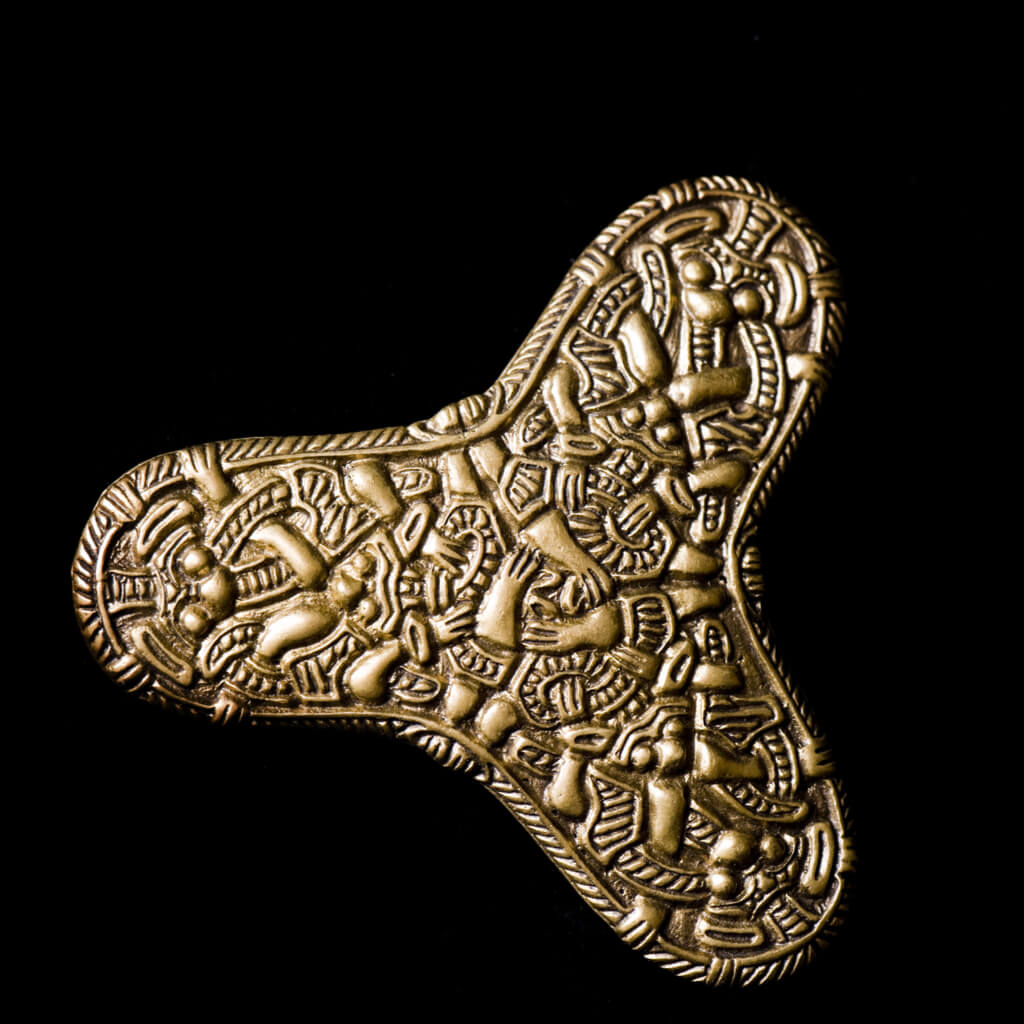
Borre added two distinctive ideas to the earlier repertoire: the "ring-chain" (a plaited ring-braid interlace) and a gripping beast with a mask-like, almost triangular face, prominent eyes, and clawing paws, set among tight geometric knot patterns. It was above all a style for metal jewellery. Where an Oseberg piece might carry a fairly plain animal-head post, a Borre craftsman filled the surface with ring-chain and knotwork. As Norse settlers and traders travelled, they carried Borre ornament with them, and the style also appears on some of the finest Viking-inspired woodwork.
YOU MAY LIKE: Drakkar Ship Handcrafted Bronze Viking Ring
Jelling style (c. 900–975 AD)

The Jelling style (sometimes spelled Jellinge) was current from about 900 to 975 AD and is primarily a metalwork style. It is named after a small cast-silver cup found in the north mound, the royal grave, at Jelling in Jutland, Denmark. The style bridges Borre and Mammen.
Its hallmark is the ribbon-shaped, S-shaped intertwined "beast." These animals are shown in profile, with open jaws, a curling lip-lappet, and a pigtail, and their bodies are drawn as narrow ribbons defined by a double outline. It is worth clearing up a common mix-up: the style is named after the silver Jelling cup, not the great Jelling runestones themselves, which carry later ornament influenced by the Mammen and Ringerike styles. As the 10th century drew on, Jelling gradually gave way to a bolder new manner: Mammen.
Mammen style (c. 950/970–1025 AD)
The Mammen style emerged around 950 to 970 AD and lasted until roughly 1000 to 1025 AD. It is named after a silver-inlaid iron ceremonial axe from the Bjerringhøj chamber grave at Mammen, near Viborg in Jutland, Denmark. This was a magnate's burial, dendrochronologically dated to the winter of 970 to 971. The mound was first dug into by a farmer in 1868, and the chamber held a high-status man laid on a down-cushioned bed in embroidered garments trimmed with silk and fur.
Where earlier styles crowded the surface with many small creatures, Mammen favours a single large, substantial beast, often the lion-like "great beast," with a pelleted (dotted) body, shell-spiral hips, and semicircular nicks along its contours. Its real importance is a first: Mammen introduced foliate plant ornament, tendrils derived from the acanthus leaf, into Viking art. The Mammen axe itself shows a bird on one face and a foliate design on the other. The style gradually merged into Ringerike, and the finds are displayed at the National Museum of Denmark in Copenhagen. A quick correction of an old story: the axe did not come from Harald Bluetooth's mound; it is simply the type-object of the Mammen style.
YOU MAY LIKE: Norse Vikings Legendary Mammen Axe Pendant Mammen Style Large Axe
Ringerike style (c. 990/1000–1050 AD)
The Ringerike style flourished from about 990 to 1050 AD and grew directly out of Mammen. It is named after the Ringerike district north of Oslo, Norway, whose reddish sandstone was carved in the style. It is named for the district, not for a single object, though the Vang stone (from Vang in Valdres) and the Alstad stone are the type-monuments most often cited.
Ringerike takes Mammen's plant ornament and elaborates it into long, thin, symmetrical tendrils and lobes that spring from shell-spirals, often gathering into bundles that end in tight spirals. Its animals, a slimmer, more curvaceous great beast alongside lion and serpent figures, have almond-shaped eyes rather than round ones, and undecorated bodies. This is where you see the clear contrast with the earlier styles: Ringerike creatures are drawn exceedingly thin and long, whereas the older animals were thick and round. The style went on to influence art in England, Ireland, and the rest of Scandinavia.
Urnes style (c. 1040–1150 AD)
The Urnes style is the final Viking art style, current from about 1040 to 1150 AD and extending into the early medieval and Romanesque period. It is named after the carved wooden portal on the north gable of the Urnes stave church at Ornes in Luster, western Norway, a UNESCO World Heritage Site. Those carvings are older woodwork that was reused in the standing 12th-century church.
Urnes is the most elegant and stylised phase of the whole tradition. Slim, greyhound or serpent-like animals with almond-shaped eyes and long necks are interwoven with even thinner snakes and looping tendrils, all set in open figure-of-eight and looping compositions. A marked contrast between thick and thin lines gives the ornament its rhythm. This period coincided with the Christianisation of Scandinavia, and as the old myths gradually receded, the animal ornament grew ever more refined until it merged into Romanesque art. Urnes represents the graceful culmination of centuries of Scandinavian animal ornament.
The Features of Viking Art
When it comes to some distinctive features of Viking age art, the important one is the material. The most often material used in the making of Norse art is – you guessed it – wood.
The main reason for using wood so much is its abundance in northern Europe. The second important thing is that wood is relatively easy to carve, and because of that, it is a perfect artistic medium.
With the expansion of Christianity came the change in artistic material and stone took over as the primary material used by Viking artists. This could be seen in Jelling in Denmark, where the royal monuments are made of stone.
The last but not least important artistic material is metal. Most of today's research regarding Viking artwork comes from their metalwork. For example, Viking age jewelry was very important and was worn by both men and women.

Of course, men and women wore different types of jewelry.
Married women fastened their overdresses with a pair of big brooches. Because of its domed look, the archeologists called them "tortoise brooches." Of course, every region had its own distinctions, but they were usually based on openwork.
Men, of course, wore rings. Rings were worn on fingers, necks, and arms. Arm rings were very important for Vikings tradition since having one meant entering a lord's service and becoming an integral part of Viking society. For jewelry, Vikings usually used silver and bronze, but there was a lot of gold in some more luxurious findings.
Many metallic pieces were found in the graves of Vikings since their burying practices involved grave goods, which were used as a gift for the deceased in the afterlife. Aside from the goods, the deceased themselves were dressed in their finest robes, including a lot of jewelry, all of it to be carried into the afterlife.
Also, many of the recent Norse art findings came from hidden goods that were intended to be recovered later, but the owner, for some reason, never showed up to collect his treasure. Although, this could be a case of offering to the gods, in which case to remove it would be considered sacrilege.
In recent times, metal detecting did a lot to help Norse art investigation since many objects were found this way. This encompasses mostly Viking coins, which can be some form of art given that their design had to be created.
As you can see, almost every Viking art style was visual and involved carving and jewelry making. There were also some other forms of art such as a bit of painting and poetry, but they were nowhere near as important for the Viking world as carving.
How did the Vikings affect the art world?
Norse art and mythology have echoed through classical music, fantasy literature, heavy metal, and blockbuster cinema. Composers, novelists, and film-makers keep returning to the same medieval Scandinavian well, drawn by its striking imagery and its stories of gods, serpents, and the end of the world. The influence is less about copying Viking ornament directly and more about reviving the myths that ornament once accompanied.
Richard Wagner drew on the Norse and Germanic Völsung-Nibelung legend for his opera cycle Der Ring des Nibelungen. J.R.R. Tolkien drew on the very same Old Norse and medieval sources for The Lord of the Rings. The two did not copy each other; Tolkien himself brushed off the comparison, remarking that "Both rings were round, and there the resemblance ceases." They simply share a common ancestor in the old legends.
The myths reached metal too. Bands built a whole subgenre, "Viking metal," on Norse art and storytelling. Heavily influenced by Norse imagery, the style peaked in the early and mid-1990s and still shapes musicians today.
Marvel is the most visible modern channel of all. Its Thor comics and films draw on Norse myth, including Ragnarök, the mythological apocalypse. The 2017 film Thor: Ragnarok takes its title from that event and chiefly adapts the "Planet Hulk" and Thor storylines. (Marvel does have a minor cyborg character called Ragnarok, introduced in 2006, but the film is not his origin story.)
RELATED: Ragnarok Tapestry - Viking Wall Art
Viking Art FAQ
What are the six Viking art styles in order?
In chronological order they are Oseberg (c. 775–875), Borre (c. 850–950), Jelling (c. 900–975), Mammen (c. 950/970–1025), Ringerike (c. 990/1000–1050), and Urnes (c. 1040–1150). They overlap rather than follow one another cleanly, so two or three styles were usually current at the same time across the Viking Age.
What is the gripping beast in Viking art?
The gripping beast is an animal motif whose paws grip the border around it, its own body, or a neighbouring beast. It is the defining feature of the earliest Oseberg style and reappears, reworked, in the Borre style with a distinctive mask-like, near-triangular face. It is one of the most recognisable images in early Norse ornament.
What is special about the Mammen style?
Mammen is the moment plant ornament enters Viking art. Alongside a single large "great beast" with a pelleted body and shell-spiral hips, Mammen craftsmen introduced foliate tendrils derived from the acanthus leaf for the first time. The style is named after the silver-inlaid Mammen axe from the Bjerringhøj grave, dated to the winter of 970 to 971.
Where does the Urnes style get its name?
The Urnes style is named after the carved wooden north portal of the Urnes stave church at Ornes in western Norway, a UNESCO World Heritage Site. The carvings are older woodwork reused in the 12th-century church. Urnes is the final and most stylised phase of Viking animal ornament before it merged into Romanesque art.
Was the Mammen axe found in Harald Bluetooth's grave?
No. The Mammen axe came from the rich Bjerringhøj chamber grave near Mammen, by Viborg in Jutland, a magnate's burial dated by dendrochronology to the winter of 970 to 971. It has no verified connection to Harald Bluetooth. The axe is simply the type-object of the Mammen style and is held at the National Museum of Denmark.
Did Viking art influence Tolkien and Wagner?
Both drew independently on the same Norse and Germanic Völsung-Nibelung legends. Wagner based Der Ring des Nibelungen on that material, and Tolkien used the same Old Norse and medieval sources for The Lord of the Rings. Tolkien rejected any direct link between the two, so it is wrong to say Wagner's cycle inspired Tolkien.
Conclusion
The Vikings had a genuine gift for turning useful objects into art. From ship timbers and harness mounts to brooches, axes, and runestones, they covered the things of daily life in a living tradition of animal ornament that evolved for nearly four centuries.
Their art may not be the first thing history remembers about the Norse world, but it deserves its place. Its purpose was rarely art for its own sake; it was to beautify the objects people already used, and to carry meaning through the twisting beasts and tendrils that defined each of the six styles.
So if you have never thought of yourself as an artistic soul, take a little inspiration from the Viking approach: make the ordinary things around you beautiful.
Until our next Viking meeting, we leave you with these words of good cheer,
Skål!
Written by Bjarke Gunnar. Last reviewed July 2026.
Keep exploring: the six Viking art styles in detail, Norse symbols and their meanings, and Viking tattoo history and meaning, plus daily life in the Viking Age, or shop our Viking jewelry collection.