
The History of Viking Tattoos & Their Meanings

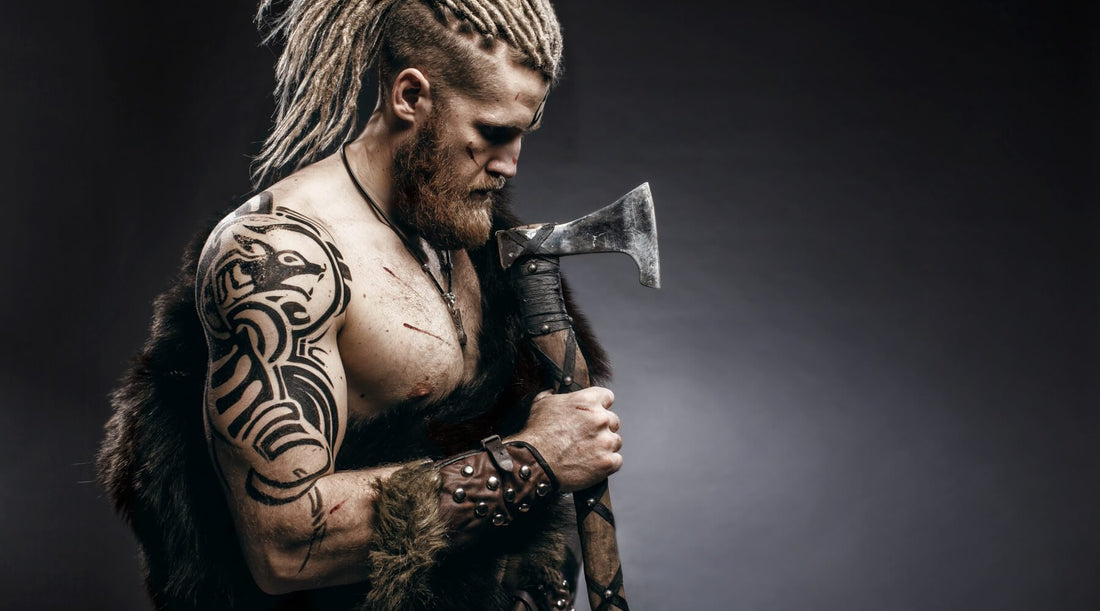
Did the Vikings have tattoos? The only direct source is the Arab envoy Ahmad ibn Fadlan, who met Rus traders on the Volga in 922 AD and described dark green figures covering them from fingernails to neck. No tattooed Viking skin has survived, so it remains one account, not proven fact. Today's “Viking tattoos” are modern interpretations of Norse symbols such as Yggdrasil, the Valknut, Mjölnir, the Helm of Awe and the ouroboros.
Tattoos were always a significant part of human social practices. Their styles, symbolism, and meanings may vary from one culture to the other, but they universally represent the same thing: a desire to improve our minds by decorating our bodies with the things we hold dear. Despite many swings that occurred in various social climates, tattoos somehow managed to swim in the ocean of contemporary trends.
According to some historical sources, tattoos were a huge part of the Viking culture as well; according to the others, there is no real evidence for us to believe so. Truth be told, unless we find a well-preserved frozen Viking deep in the mountains of Scandinavia, we will never be able to say which side of historians to join.
Below, we look at where tattooing actually came from, what Ibn Fadlan really wrote, and what the most popular Norse tattoo motifs mean today, from Yggdrasil and the Valknut to the ouroboros.
Where Did Tattoos Originally Come From?
It is not really known when humans started tattooing themselves, but we can say with absolute certainty that tattoos are almost as old as humanity itself. The oldest example of tattoos found was a body extracted from an ice glacier in the Alps. It was almost covered in tattoos (it numbered 61 tattoos). It was concluded that the body died somewhere around 3250 BC, which would make it 5000 years old. At the same time, tattoos emerged as a strong cultural tradition of Austronesian people, where it remains a popular art style even today. In Europe, the strongest culture of tattoos was among Welsh and Picts during the iron age in Great Britain. In ancient China, tattoos were considered barbaric, so they used tattoos as a method of humiliation (they used them to mark prisoners and slaves with tattoos on their foreheads as a symbol of captivity or as a sign of ownership).
On the other hand, unlike China, Japan had a very strong culture of tattoos. There, it often symbolized the social status of one person. That practice ended at one point, and from the beginning of the 17th century until the mid-19th century, tattoos in Japan were primarily worn by firemen, prostitutes, and manual workers as means of mutual identification. Also, they started using it in a similar way as the Chinese, for marking the prisoners by tattooing the symbol for a dog on their foreheads. In 1868, tattooing in Japan was outlawed, and it created a large subculture of people who had tattoos and were hence stigmatized by the rest of society. That often led them towards the criminal life and created the fertile ground for the creation of Yakuza, a gang that is active today and has a huge tattooing culture as well as tattoo artists of its own.

Yakuza girl with tattoos
When it comes to Europe, it is important to say that Picts and Welsh weren't the only ones fond of tattoos. Greeks and Romans initially used them in a similar manner as Chinese, as a method of humiliation. Later on, tattooing soldiers even became a regular practice, a practice that still lives today. Whether tattooing was equally widespread among the Vikings is a harder question, and we will get to it in a moment.
The popularity which tattoos have in modern western culture has started after James Cook's voyage to the South Pacific. However, it would be wrong to think that this voyage was the only reason for the rise of tattoo popularity. On the other hand, Cook's voyage was definitely the reason behind bringing the word "tattoo" to Europe. The word "tattoo" comes from the Tahitian word "tatau." But aside from that, there are plenty of sources that undoubtedly confirm that tattoos were very common throughout history amongst early Europeans. They were also quite common even among the pilgrims in America who had a lot of contact with tattoos through the Native American community.
Did the Vikings Have Tattoos?
If it wasn't for a man called Ahmad ibn Fadlan, a famous Arab traveler of the 10th century AD, we probably wouldn't have any reason to even ask whether the Vikings had tattoos. He wrote about many people he came in touch with, but in one of his travelogues, Ibn Fadlan describes the Rus, which are commonly known as Vikings. Although this well-known Islamic scribe had little to say about the good body smell and hygiene of the Vikings, there was nothing but words of admiration for the rest of the ways of life Vikings led. (Ibn Fadlan met the Rus on the Volga trade roads. You can read his account in its geographic context on our interactive Viking World Map.)
You mustn't forget that regardless of their backgrounds, Medieval scribes wrote in a poetic rather than informative fashion. So, for example, instead of stating that the Norse men are probably the tallest humans he met in his lifetime, Ibn Fadlan expressed his admiration lyrically and said that the Vikings are as tall as palm trees, fair and reddish. As you probably guessed, the other part of that verse refers to their light skin complexion and rosy cheeks due to the harsh climate of Scandinavia. Ibn Fadlan continues his praise, saying: "Fair and reddish, they wear neither tunics nor kaftans. Every man wears a cloak with which he covers half of his body so that one arm is uncovered. They carry axes, swords, daggers and always have them to hand. They use Frankish swords with broad, ridged blades."
Some of you may wonder why one man's impressions carry so much weight in answering the question: did Viking tattoos really exist? Well, Ibn Fadlan wrote one sentence that would keep historians arguing for centuries. During his 922 AD mission to the Volga Bulgars, where he met the Rus far from Scandinavia, he recorded that their bodies were marked from fingernails to neck with dark green figures and trees. The dark green and blue tones suggest the pigment was probably made from wood ash. Some scholars also note that his Arabic wording could describe body paint as easily as tattooing, one more reason the case stays open.
Despite the fact that Fadlan was a prominent Medieval figure and that his words were valuable among both his contemporaries and the later day historians, it would be fair to wonder: How come no one else wrote about this noticeable fact regarding the ink used for Viking tattoo? How come Viking literature covered every aspect of their daily lives (including hairstyles, fashion, and jewelry) but never mentioned that the symbols, designs, and Norse gods valued the most weren't only written on stones and weapons but were tattooed on their own skin?
These days, Viking symbolism is everywhere. Trends in symbols you would see on tattoos can be seen on everything from viking weaponry and axes, casual and street clothing, symbolic norse jewelry, beard grooming products, and other accessories such as wallets.
Most Common Viking Tattoos

Tattooed Viking warrior
If the Rus that Ibn Fadlan saw really were tattooed, historians reason that the designs were probably no different from the symbols Vikings carved into wood, stone, and metal. No single motif can be tied to Viking skin with certainty, though. So in this segment of the article, we are going to talk about the most often used symbols people choose for Norse tattoos today, and what each one meant in the original sources.
A quick word before the list: many people today ink actual Old Norse words rather than symbols, and that is where most mistakes happen, because half the “Viking phrases” online are modern inventions. If that's your plan, start from sources you can check: our tattoo-ready Viking quotes in Old Norse (attested Hávamál and saga lines, each with its medieval source and runes), the Old Norse translator for single words verified against Zoëga's dictionary, and the Rune Translator for writing a name in Younger Futhark. Whatever you choose, have it double-checked before the needle touches skin.
Knowing that Norse mythology played such a huge role in the daily lives of Vikings, it is easy to imagine that if they did wear tattoos, its stories would have supplied the motifs, with the gods, especially Odin, as the likeliest subjects. That part remains speculation. What is certain is that Norse mythology symbols, such as the Valknut and Sleipnir, stay firmly relevant in the world of tattoo art. Let's take a look at some of the most popular Viking tattoos nowadays.
Yggdrasil - The Tree of Life
The Nordic sacred tree of life, Yggdrasil, is today one of the most popular Norse tattoo motifs of all. The tree is named in the poems of the Poetic Edda and described in detail in Snorri Sturluson's Prose Edda in the 13th century. Snorri describes Yggdrasil as a giant ash tree placed in the middle of the cosmos, whose branches could touch the heavens and whose roots reached deep into the Earth, binding together the nine realms of existence. As a tattoo, Yggdrasil represents the cycle of life and the connection between all worlds. So if you are lacking tattoo ideas and want to pay homage to the Norse worldview with something with a deeper meaning, Yggdrasil would probably be the right choice.
Valknut - The Triple Knot of the Slain Warriors
Another popular Viking symbol that you might want to take into consideration when choosing the proper image for your new tattoo would undoubtedly be the symbol of Valknut, the triple knot of the slain warriors who are ready to be greeted by Odin. Because of its simplistic design, Valknut would be the right choice for all of you that want to keep their tattoos subtle yet meaningful. The symbol of Valknut consisted of three interlocking triangles that probably also represented the heart of Hrungnir, a brave giant made of stone. Therefore, we can surely say that Valknut's meaning is connected to fearlessness when it comes to accepting death as nothing but the natural part of life. Unlike many "Viking" designs, this one is genuinely attested in the Viking Age, on Gotland picture stones and objects from the Oseberg burial, though the name Valknut itself is modern. Our guide to the Valknut meaning covers its history and the theories behind it in more depth.
Vegvisir - The Nordic Compass
Many tattoo artists still find inspiration for their art in various Norse designs. The symbol of Vegvisir, commonly known as the Nordic compass, is undoubtedly one of them. Vegvisir is believed not only to be the symbol of travelers and seafarers but the symbol of guidance and shelter during hard times: the Icelandic manuscript that records it promises that its bearer will never lose their way in storms or bad weather. One honest caveat, though. The Vegvisir is not a Viking Age symbol at all; it first appears in Icelandic manuscripts of the 19th century, long after the last longship sailed. It belongs to the later Norse tradition rather than to the Vikings themselves, which is worth knowing before you ink it (for a modern take on Norse-style linework, see our Odin tattoo style hoodie).
Helm of Awe - Viking Tattoo for the Most Courageous Ones

Helm of awe
When talking about Norse tattoo history and art, it is difficult not to mention Aegishjalmur, or as we know it today, the Helm of Awe. The name itself is genuinely medieval: in the Poetic Edda, the dragon Fafnir boasts of the aegishjalmr, the "helm of awe" that made every creature tremble before him. The eight-armed stave design we use today, however, comes from Icelandic grimoires written in the 17th to 19th centuries, well after the Viking Age, and although it resembles the Vegvisir, its meaning is quite different. The Helm of Awe stands for courage and protection, the belief that terror strikes your enemies instead of you. And if you sometimes feel that you need some protection on the battlefield of life, we surely recommend a tattoo of nothing but the Helm of Awe.
RELATED: Viking Warrior Tattoo Style Sweater
Sleipnir - Odin's Stallion
Whether you consider yourself an animal lover or not, it is hard to believe that you wouldn't like Sleipnir, an eight-legged stallion of Odin, who is considered to be the fastest of all creatures on Earth. So if you sometimes feel like you cannot manage to do it all by yourself, get a tattoo of Sleipnir and sleep peacefully, knowing there is someone who will carry you whenever your legs get tired.
Mjollnir - The Hammer of Thor
According to Norse mythology, there was no more powerful weapon than Mjölnir, the notorious hammer of Thor. Mjölnir could cause storms, earthquakes, floods, and wars in just several minutes. So who wouldn't like to have such a powerful weapon when dealing with everyday hurdles as their tattoo?
Ouroboros - The Serpent That Bites Its Own Tail
The ouroboros, a serpent swallowing its own tail, has become one of the most requested Norse-style tattoos, and unlike Vegvisir it has a real anchor in the medieval sources. In Gylfaginning, Snorri Sturluson writes that Jörmungandr, the Midgard Serpent, grew so vast that it lies in the ocean around all lands and bites its own tail. As a tattoo, the ouroboros usually stands for cycles, renewal and endurance, the idea that every ending feeds a new beginning. The design itself is far older than the Norse: it first appears in ancient Egypt, on a shrine from Tutankhamun's tomb. We trace that whole journey, from Egypt to Jörmungandr and modern ink, in our full guide to what the ouroboros means.
What do Viking Tattoos Represent?
As you can see, Viking tattoos today are based on some of the most prominent Norse symbols and mythical stories. The designs aren't picked randomly: people choose them for protection, guidance, and a sense of identity, exactly the roles those symbols played when Vikings carved them into runestones, weapons, and jewelry (see our Viking runes charm beads for your beard). A well-chosen Norse tattoo can still say a great deal about the wearer: their roots, the values they live by, and the gods and stories they feel closest to.
It is tempting to go further and imagine Viking tattoos as magical marks of wealth, war luck, or coming of age, and you will find plenty of websites that state exactly that as fact. The honest answer is that no source describes any of it. Everything we know comes down to Ibn Fadlan's single sentence about dark green figures, and everything beyond it is a modern guess. What the Vikings verifiably did was pour those meanings into the symbols themselves, and that is the tradition a modern Norse tattoo carries on.
Conclusion
We hope that after you've read this article, you realized what a common misconception is that Viking tattoos are only meant for those of Scandinavian descent. You don't have to be a biological heir of Odin to proudly carry some of his symbols with you at all times. All you really need to possess in order to treat yourself with some of the many awesome Viking tattoos is love and appreciation for Norsemen, their culture, and tradition. And being such a faithful VikingsBrand reader, we have no doubt that you already have all virtues of a true Viking.
Keep exploring: go deeper into Norse mythology symbols and meanings, read about the meaning of wolf tattoos and the Helm of Awe, or shop our Viking jewelry collection.
Viking Tattoos FAQ
Did the Vikings really have tattoos?
Possibly. The only written source is the 10th-century Arab traveler Ibn Fadlan, who described the Rus as tattooed dark green or blue from fingertips to neck. No tattooed Viking skin has ever survived, so it remains a single account rather than proven fact.
What do Viking tattoos mean?
Most modern Viking tattoos use Norse symbols: Yggdrasil for the cycle of life, the Valknut for the slain warriors of Odin, the Helm of Awe for courage and protection, Vegvisir for guidance, and Mjölnir for Thor's strength.
What does an ouroboros tattoo mean?
In Norse terms the ouroboros is Jörmungandr, the Midgard Serpent, which Snorri's Gylfaginning says encircles the world and bites its own tail. As a tattoo it stands for cycles, renewal and endurance. The image itself is far older than the Vikings; it first appears in ancient Egypt.
Are the Vegvisir and Helm of Awe authentic Viking symbols?
Not from the Viking Age itself. Both first appear in Icelandic grimoires from the 17th to 19th centuries, long after the Vikings. They are genuinely Norse-tradition symbols, but calling them “Viking” is a modern stretch, worth knowing before you ink one.
Do you have to be Scandinavian to get a Viking tattoo?
No. There is no ancestry requirement. Anyone who respects Norse culture and its symbolism can wear a Viking tattoo.
How do I get an Old Norse phrase right for a tattoo?
Start from sources you can verify (attested quotes with a named source and dictionary-checked words) rather than a random image online, because most “Viking phrases” on the internet are modern inventions or broken grammar. Then have a specialist confirm it before the needle touches skin.
Until our next Viking meeting,
Skål!
1 comment
My grand parents came to Canada about 1930, our name was Storbacka, got shortened to Storr, I’ve started getting Scandinavian tattoos plan to get more, but thought I should research some meanings, have the family name on me now though