
Viking and Norse Runes: The Runic Alphabet Guide

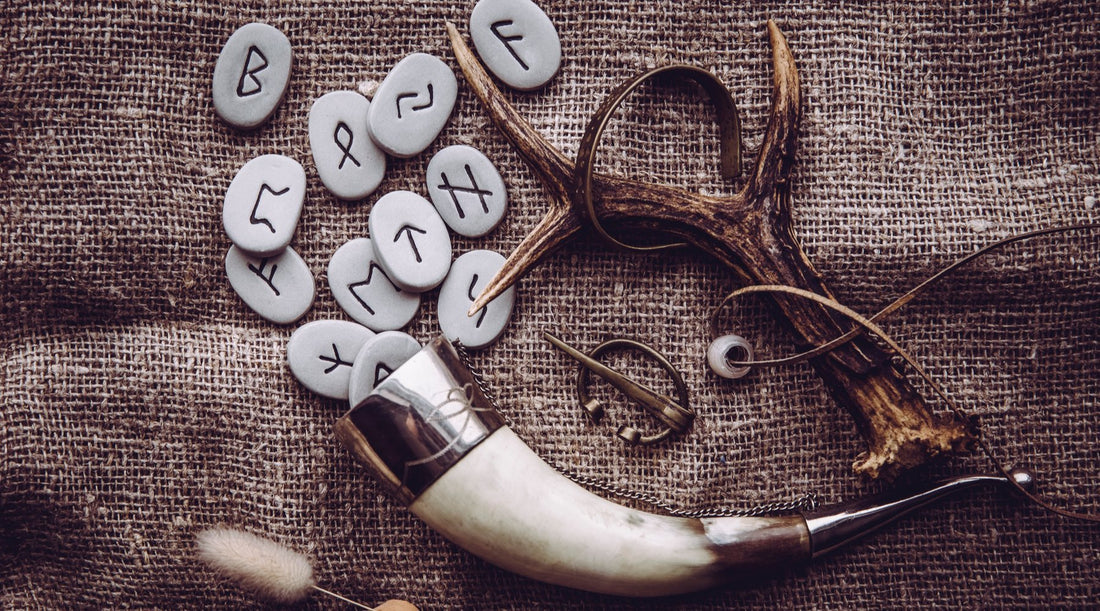
Viking runes are the letters of the runic alphabets, or futharks, that the Norse and other Germanic peoples carved from the 2nd century AD into the Middle Ages. The Elder Futhark held 24 runes; the Vikings themselves wrote with the Younger Futhark of just 16. Every rune stood for a sound and had a name that was also a word, such as Fehu, "cattle" and wealth.
A third system, the Anglo-Saxon futhorc of up to 33 runes, served early medieval England. Vikings carved runes onto stone, wood, bone and metal to record names, mark memorials and send messages, and sometimes to carry charms and curses.
This guide explains where the runes came from, what the three futharks are, what the best-known runes mean, and the famous myth of how Odin won them. Want to see your own name in runes first? Use our free Rune Translator to write any word in the Elder, Younger or Anglo-Saxon alphabets. And remember the distinction: runes are an alphabet; the language they wrote was Old Norse. Our Old Norse translator finds the actual words the Vikings used, verified against Zoëga's dictionary, with the runes included.
What are Viking runes?
Viking runes are characters in a writing system called the futhark, named after the sound values of its first six runes: F, U, Þ (th), A, R and K. Before the Latin alphabet reached the North, Germanic peoples wrote in runes across many related languages. The Norse used them for practical records like ownership and trade, for memorial stones raised to the dead, and for charms meant to heal, protect or curse.
Norse culture was largely oral, so the poems and stories were spoken and memorised, and were written down only later, in the Latin alphabet, mostly in 13th-century Iceland. Runes were used for shorter inscriptions: a name, a claim, a memorial, a charm. Most surviving runestones stand in Sweden, with more across Norway and Denmark, and runic graffiti left by travelling Norsemen has been found as far away as Orkney and Istanbul (Constantinople). You can visit both carving sites on our interactive Viking World Map.
Nearly all runestones are memorials from the late Viking Age, raised in the 10th and 11th centuries for a dead father, son, brother or husband. Two of the most famous are the Rök stone in Östergötland, Sweden, carved in the early 9th century with the longest runic inscription known on any stone, and the larger Jelling stone in Denmark, raised around 965 by King Harald Bluetooth for his parents Gorm and Thyra, which says that Harald won all of Denmark and Norway and made the Danes Christian.
Norse runes, Viking runes, runic alphabet: are they the same?
Mostly yes, and the different names cause more confusion than the runes themselves. They point at the same set of carved letters from slightly different angles.
- Norse runes and Viking runes. The same letters. "Norse" names the people and their language, "Viking" names the era and the seafaring, so the two labels get used interchangeably for the runes of Scandinavia.
- Runic alphabet, rune alphabet, Viking alphabet. The writing system itself rather than any single letter. Strictly it is a futhark, named after its first six runes, and there is more than one of them.
- Old Norse runes. The runes used to write the Old Norse language, which in practice means the 16-rune Younger Futhark of the Viking Age and the medieval runes that grew out of it.
- Scandinavian runes and the Nordic alphabet. Looser labels, usually pointing at that same Younger Futhark rather than the older 24-rune row.
So if you searched for any of those and landed here, you are in the right place. The section below sets the three alphabets side by side.

Handmade Elder Futhark runes
The three futharks: Elder, Younger and Anglo-Saxon
There are three main runic alphabets. They overlap in shape but differ in the number of runes and the period and place they were used.
- Elder Futhark, 24 runes (c. 150 to 800 AD). The oldest and most complete system, used across the Germanic world until the 8th century, when Scandinavians reduced it to the Younger Futhark. It is the alphabet most people mean by "Viking runes" today, and the one rune-meaning guides are usually based on, but in Scandinavia it had largely gone out of use before the Viking Age began.
- Younger Futhark, 16 runes (c. 800 to 1100 AD). A reduced set that Scandinavians actually used through the Viking Age proper. Fewer runes had to cover more sounds, so several letters did double duty. It came in two main varieties: long-branch runes, common in Denmark, and the quicker short-twig runes, common in Sweden and Norway.
- Anglo-Saxon futhorc, up to 33 runes (c. 5th to 11th century). Used in early medieval England and Frisia, where the alphabet grew rather than shrank, adding runes for the sounds of Old English.
After about 1100 the Younger Futhark grew into the medieval runes, which added dotted runes for extra sounds and were used alongside the Latin alphabet. Around 1300 a scribe even wrote out the Scanian Law in runes, in the manuscript now called the Codex Runicus.
The name of each alphabet comes from its first six runes, exactly the way "alphabet" comes from alpha and beta. You can switch between all three and compare them side by side in our Rune Translator.
Where the runes came from
The origin of the runic script is still debated. Most scholars think the runes were adapted from an Old Italic (North Italic) alphabet, the family of scripts used in northern Italy and the Alps before Latin took over, and that Germanic people who served with or traded alongside Rome carried the idea north. A minority argue for a more direct Latin origin. What is clear is that the shapes suit carving: mostly straight staves and diagonals with few curves. Many scholars explain the lack of horizontal strokes by the grain of wood, in which a horizontal cut is hard to see.
The Kylver Stone from Gotland, Sweden, dated to around 400 AD, carries the oldest known listing of all 24 runes of the Elder Futhark, in nearly the standard order. The earliest inscriptions are older still: a comb from the Vimose bog on Funen, Denmark, carved with the word harja around 160 AD, and a spearhead from Øvre Stabu in Norway, inscribed raunijaR, "tester", in the late 2nd or early 3rd century.
What Viking runes mean
Every rune had a name that was also a word, so each carried a plain meaning (Fehu means "cattle," Uruz means "aurochs") long before it was ever used for fortune-telling. No list of the Elder Futhark names survives from the time: the names used today are reconstructed from three medieval rune poems, the Old English, the Old Norwegian and the Old Icelandic, so some are certain and some are educated guesses. The mystical readings below come mainly from modern rune divination rather than the Viking Age itself, so treat them as tradition and interpretation, not history. Modern rune casting often points to the Roman historian Tacitus (Germania, chapter 10), who describes Germanic peoples cutting a fruit-tree branch into slips marked with signs and reading three of them, but he does not say the signs were runes, and no Norse source describes reading runes this way. For the full 24-rune list with sound values, see our Elder Futhark rune meanings guide. Here are ten of the best known Elder Futhark runes.
Fehu (ᚠ), "cattle," wealth

Fehu literally meant cattle, the movable wealth of a Norse household. In modern readings it stands for prosperity and earned abundance, with a reminder to keep and grow what you have already won rather than waste it.
Uruz (ᚢ), "aurochs," strength

Uruz was named for the aurochs, the wild ox of Europe, according to the Old English rune poem; in the two Norse poems its name, úr, means drizzle or slag instead. In modern readings it speaks of raw strength and of leaving one stage of life behind for the next, the end of an old chapter and the start of a stronger one.
Ansuz (ᚨ), "a god," wisdom and the spoken word

Ansuz is usually reconstructed as "a god," one of the Æsir. The Old Icelandic rune poem ties its Norse form, óss, to Odin as lord of Asgard and Valhalla, while the Old Norwegian poem reads óss as a river mouth. In modern readings it is the rune of the spoken word, of messages, insight and sacred knowledge, and it counsels care and patience in what you say.
Nauthiz (ᚾ), need and hardship
Nauthiz means need. In readings it marks constraint and difficulty, and advises anyone who draws it to slow down, rebuild their plans and work patiently through hard times rather than force a way out in anger.
Gebo (ᚷ), a gift

Gebo means gift. It stands for generosity, partnership and the balance between what is given and what is received, whether in friendship, love or trade.
Wunjo (ᚹ), joy

Wunjo means joy. It is the light after a hard stretch, a sign of harmony and confidence once sadness has passed, and of ease between your deeper self and your everyday mind.
Algiz (ᛉ), protection

Algiz is the rune of protection and steady nerves in modern readings, but its old name is uncertain. It is usually reconstructed as "elk", and the Old English rune poem calls it eolhx, elk-sedge, a marsh grass that cuts anyone who grabs it. In readings it counsels controlling your emotions through change, so that even a battle you cannot win leaves you wiser rather than broken.
Perthro (ᛈ), mystery and fate

Perthro is the most mysterious of the runes: no one knows what its name meant. The Old English rune poem's peorð is unexplained, and the idea that it was a cup for casting lots is a modern guess. In readings it stands for mystery, chance and hidden gains, the forces at work in a life that are not easy to name.
Ingwaz (ᛜ), fertility and new life
Ingwaz is named for Ing, who according to the Old English rune poem was first seen among the East Danes; he is often linked with Yngvi-Freyr, the god of fertility. In readings it represents new life and completion, the sowing that must happen before any harvest, and the right of anyone to begin a fresh chapter.
Othala (ᛟ), heritage and home

Othala means ancestral property and inheritance. It speaks of home, family and what is passed down, and of the wisdom to shed the old when it is time so something new can grow.
Runes, magic and the Norns
Because runes could fix words in stone and metal, people believed they could fix intentions too. Surviving inscriptions, from the Viking Age and the centuries after it, include love messages, healing charms and curses on anyone who would damage a memorial stone. The poems go further. In Sigrdrífumál the valkyrie Sigrdrífa teaches the hero Sigurd runes for every need: victory runes to carve on a sword's hilt while naming Týr twice, birth runes for the palms, sea runes for a ship's prow and rudder blade, and limb runes, cut on the bark of a tree, for anyone who would be a healer.
The sagas show runes at work too. In Egils saga, written in 13th-century Iceland, Egil carves runes on a drinking horn, reddens them with his own blood, and the poisoned horn bursts (chapter 44). Later he finds a sick girl, Helga, whose rejected suitor had tried to carve love runes for her and got them wrong; Egil scrapes off the bad runes, burns them, carves new ones, and she recovers. His verse gives the moral: no one should carve runes who cannot read them well (chapter 72; the suitor's motive comes out in chapter 76).
In myth, fate is carved too. The world tree Yggdrasil stands over the well of Urðr, and in Völuspá (stanza 20) three maidens come from the lake under the tree: Urðr, Verðandi and Skuld, the Norns. They "cut on a slip of wood", laid down laws and chose the lives of the children of men. The poem has them carve on wood, not into the tree, and it does not say outright that the marks were runes; the Norns carving runes into Yggdrasil's trunk is a modern retelling.

Viking runestones
How Odin won the runes
The most famous rune myth is Odin's own. In the poem Hávamál in the Poetic Edda, Odin says that he hung on a windy tree for nine whole nights, wounded with a spear and given to Odin, himself to himself, on a tree of which no one knows from what roots it runs (stanza 138). The poem does not name the tree; most readers take it to be Yggdrasil, whose name probably means "Odin's steed", a poetic word for the gallows. No one refreshed him with bread or drink, Odin says; he peered down, took up the runes, took them up screaming, and fell back from there (stanza 139).
Right after, he learns nine mighty songs and gets a drink of the precious mead (stanza 140). Later the poem lists eighteen charms Odin knows: one for those who would be healers, one to blunt an enemy's blades, one to quench a burning hall, one to calm wind and sea when his ship is in danger, and one he chants under the shields so his friends go safe into battle and come safe home. One of them uses the runes directly: he carves and colours them to make a hanged man walk and talk with him (stanza 157). The myth frames the runes as knowledge won through suffering. (Hávamál is also the best-known collection of Norse wisdom verse. Its most famous verses, with sources and runes, are in our collection of real Viking quotes in Old Norse.)
The blank rune

You will sometimes see a blank rune, called Wyrd, sold in divination sets. It is worth being clear: the blank rune was introduced by Ralph Blum's The Book of Runes (1982), which came with a set of rune tiles including one blank, and it is not part of any historical futhark. Wyrd itself is an Old English word for fate, a cousin of the Norse name Urðr. In readings it is taken to mean the unknowable or fate itself, a prompt to look inward, but no Viking ever carved it.
Viking runes today
Runes never fully disappeared: in parts of Sweden, especially Dalarna, people still wrote in a local runic script into the 1800s. Runology, the study of runic inscriptions, still reconstructs Norse trade, law and daily life from carved stones. The Kjula Runestone in Södermanland, Sweden, for example, was raised by Alríkr for his father Spjót, who, its verse says, had been in the west, had broken towns and fought at them.
Runes also live on in modern culture. J.R.R. Tolkien used Anglo-Saxon runes on the map in The Hobbit before inventing his own Cirth script for later books, and runes appear across fantasy novels and video games. Even the Bluetooth logo is a bind rune: it combines the Younger Futhark runes for H and B, the initials of the Viking-age Danish king Harald Bluetooth (Blåtand in Danish), the same Harald who raised the great Jelling stone.

The Bluetooth logo, a bind rune of Harald Bluetooth's initials
Write your name in runes
The easiest way to get a feel for the runes is to use them. Our free Rune Translator turns any name, word or oath into Elder, Younger or Anglo-Saxon runes, and lets you download it as a poster; to find real Old Norse words to write, use the Old Norse translator. Many of the same symbols are cast into our Viking rings and Viking necklaces, and you can read the wider symbol set in our guide to Norse mythology symbols and their meanings.
Viking runes, FAQ
What are Viking runes?
Viking runes are the letters of the runic alphabets used by the Norse and other Germanic peoples from about the 2nd century AD. They were carved into stone, wood, bone and metal to record names, raise memorials, and sometimes to carry charms and curses. The Vikings themselves wrote with the 16-rune Younger Futhark.
What are the three types of runes?
The three main runic alphabets are the Elder Futhark (24 runes, c. 150 to 800 AD), the Younger Futhark (16 runes, used through the Viking Age, c. 800 to 1100 AD), and the Anglo-Saxon futhorc (up to 33 runes, used in early medieval England). After about 1100 the Younger Futhark developed into the medieval runes.
How many runes are in the Elder Futhark?
The Elder Futhark has 24 runes. Its name comes from the sound values of its first six: F, U, Þ (th), A, R and K. It is the alphabet most rune-meaning guides are based on.
What do Viking runes mean?
Each rune had a name that was also a word, such as Fehu ("cattle," wealth) or Hagalaz ("hail"). The Elder Futhark names are reconstructed from medieval rune poems; the fortune-telling meanings attached to each rune come mainly from modern rune divination. See our Elder Futhark rune meanings guide for the full list.
Did Vikings use runes for magic?
Runes were used for charms as well as writing. Surviving inscriptions include healing charms and curses on anyone who damages a memorial stone, and the poem Sigrdrífumál lists runes for victory, childbirth, safe sailing and healing. In Hávamál, Odin hangs nine nights on a windy tree to win the runes. The Norns in Völuspá cut on a slip of wood; the idea that they carved runes into Yggdrasil is modern.
How do I write my name in runes?
Use our free Rune Translator. Type your name and it renders it in Elder, Younger or Anglo-Saxon runes, which you can copy or download as a poster. Runes are phonetic, so it maps the sounds of your name rather than the Latin letters one to one.
Are Norse runes and Viking runes the same thing?
Yes. They are two names for the same carved letters. "Norse" refers to the people and their language, "Viking" to the era and the voyages, so both labels describe the runes of Scandinavia and the wider Germanic world.
What is the runic alphabet?
The runic alphabet is the writing system the runes belong to, properly called a futhark after the sound values of its first six characters. There are three main ones: the 24-rune Elder Futhark, the 16-rune Younger Futhark, and the Anglo-Saxon futhorc of up to 33 runes.