
The Norse Giants - History, Culture & Mythology

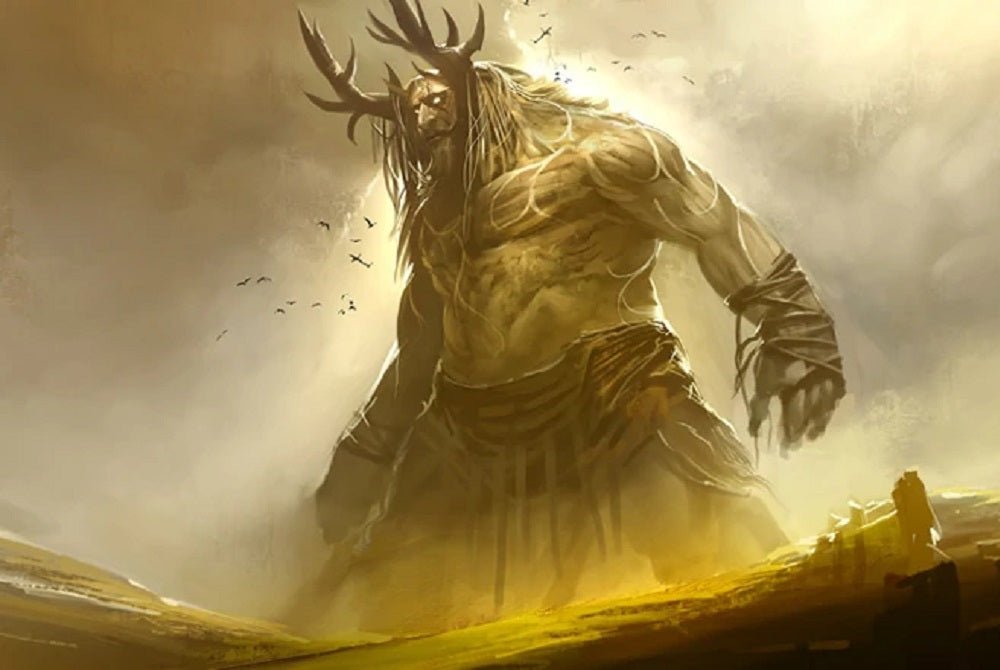
The Giants of Norse mythology, the Jötnar (singular jötunn), are the oldest family in the Norse story of the world. The first living being was the giant Ymir, who came to life in the void of Ginnungagap where rime met heat, and the frost giants descend from him. They are the gods’ great rivals, yet also their kin: Odin’s mother, Bestla, was a giant’s daughter. Far from simple monsters, the Jötnar stand for the raw, chaotic forces of nature, and in Snorri Sturluson’s account the ordered world of the gods is built from a giant’s body.
The Giants of Norse mythology are important in many respects. They're also varied in the way people describe them. Whether you know them as Frost Giants, Norse Giants, Jötnar, or another name from Viking lore, you're probably curious about the exact nature of these Giants.
This article covers who the Giants of Norse mythology are, why they're significant, and explores some of the various interpretations found from different sources.

Who Were the Giants in Norse Mythology?
Let's dive into who the Giants were, what they symbolize, and how they tie into the greater Norse pantheon.
Ymir: The First Giant
Ymir, pronounced as "EE-mir," is the first living being in Old Norse myth. The fullest account is in Gylfaginning, the first part of the Prose Edda that Snorri Sturluson wrote around 1220. There Ymir comes to life from the meeting of cold and heat: the ice and rime of Niflheim in the north and the sparks and warm air of Muspelheim in the south.
Modern books count Muspelheim and Niflheim among the nine worlds of Norse myth, though no medieval text lists all nine. In the sources they do not float or collide. Between them lay Ginnungagap, a vast empty gap that existed before the earth was made. Its northern part filled with heavy ice and rime, its southern part met the sparks flying out of Muspelheim, and the middle was as mild as windless air.
Where the rime met the warm air, it thawed and dripped, and life quickened in the drops, Snorri says, through the power of the one who sent the heat. The drops took the shape of a man, and this was Ymir. The frost giants call him by another name, Aurgelmir. The same dripping rime then formed the cow Auðhumla, whom we'll discuss soon.
Birth of The Gods
Ymir needed no partner to have children. Snorri says that while he slept he sweated, a man and a woman grew under his left arm, and one of his legs begot a son with the other. From them came the families of the frost giants. The poem Vafþrúðnismál (stanza 33) tells it the same way and adds that the son had six heads. Ymir fed on the milk of the cow Auðhumla (also spelled Auðumbla), from whose udder ran four rivers of milk.
Auðhumla was a primeval cow, and the sources never call her a goddess. She is integral to the Norse creation myth all the same, as she feeds Ymir and uncovers Búri, the grandfather of Odin, by licking the salty rime-stones. On the first evening a man's hair came out of the stone, on the second day his head, and on the third day the whole man. Snorri describes Búri as fair, big and mighty, but does not call him a god or a giant.
This connection is important because Búri had a son named Borr, who married Bestla, the daughter of the giant Bölþorn. Snorri does not trace Bölþorn's line back to Ymir, but a verse he quotes says that all giants come from Ymir. Borr and Bestla's sons would become some of the most important figures in Norse lore.
From Ymir and Búri to Odin

Borr and Bestla had three sons: Odin, Vili and Vé. Odin would be the key figure in the Norse pantheon and the highest of the Aesir gods. He also goes on to have Thor, Höðr, Baldr, and other children that would turn out to be extremely important Norse gods.
The key thing to note is that the leading Norse gods have giant blood: Odin is half giant through his mother, and every god descended from him shares that giant blood. Even though gods and frost giants were kin, they became deep enemies. Snorri's narrator even refuses to call Ymir a god: "He was evil, and all his kin. We call them frost giants."
Ymir Continued
Ymir's importance as the first being didn't make him good, at least in Snorri's telling, which calls him evil. The sources never say what he did to deserve that name, or why the sons of Borr turned on him.
Odin, Vili and Vé, the sons of Borr, killed Ymir. So much blood ran from his wounds that it drowned all the frost giants except one, whom the giants call Bergelmir. He climbed onto his lúðr with his wife, who is not named, and was saved, and the later families of frost giants come from the two of them. The word lúðr is obscure: it is often translated "ark" or "boat," but Snorri uses the same word for Heimdallr's horn. In Vafþrúðnismál, Bergelmir is Aurgelmir's grandson, and the oldest thing the wise giant of the poem remembers is Bergelmir being laid on a lúðr; the poem says nothing of a flood.
The Creation of Earth in Norse Myths
After killing Ymir, Odin and his brothers carried his body into the middle of Ginnungagap and made the earth from it. His flesh became the land, and his blood became the sea and the lakes. The gods laid the sea in a ring around the earth.
His bones became the mountains, and his teeth, molars and broken bones became rocks and scree. His hair turned into trees, as the poem Grímnismál (stanza 40) puts it. The gods raised his skull over the earth as the sky and set a dwarf under each of its four corners. Finally, they threw his brains into the air to make the clouds.
The brothers gave the giants land along the shore of the ocean. Further in, they built a wall around the world against the giants from Ymir's eyelashes (Old Norse brár, which many translators render as "brows") and called it Midgard. Then, walking along the seashore, the brothers found two trees, or logs, and made people from them. The first brother gave them breath and life, the second wit and movement, and the third a face, speech, hearing and sight. The man was called Askr and the woman Embla.
According to Snorri Sturluson, these were the first two humans, and all humankind comes from them.
Are The Norse Giants Good or Bad?
The Jötnar are often described as enemies of the gods, so we tend to think of them as negative forces. That said, not every Giant is bad, and they're not always against the gods. In fact, there are so many interweavings between Norse Giants and gods that it's difficult to differentiate them in some cases.
Several gods have a Giantess for a mother. As we mentioned, Odin's mother Bestla was a giant's daughter. The silent god Víðarr is the son of the giantess Gríðr, who lends Thor her belt of strength, her iron gloves and her staff before he faces the giant Geirröðr. Thor's son Magni, who at three nights old lifts the dead giant Hrungnir's leg off his father, is the son of the giantess Járnsaxa. The Prose Edda shows us numerous examples of friendly Giants and interactions between the Jötnar and the Aesir.
Gods also marry into giant families. The sea god Njörðr married Skaði, daughter of the giant Þjazi, who came to Asgard armed to avenge her father and was offered a husband instead, chosen by his feet alone. The god Freyr fell so hard for the giantess Gerðr, daughter of Gymir, that he gave away his sword to win her, a story told by Snorri and in the poem Skírnismál. Odin spent three nights with the giantess Gunnlöð to win the mead of poetry that her father Suttungr kept, and Loki fathered Fenrir, Jörmungandr and Hel with the giantess Angrboða.
Other giants are the gods' great opponents, and most of them meet Thor. The giant Þrymr, whom the poem Þrymskviða calls the lord of the þursar, steals Thor's hammer and asks for Freyja as the price, so Thor goes to the wedding dressed as the bride. Hrungnir, whose head and heart are made of stone, duels Thor and dies. Þjazi carries off the goddess Iðunn, whose apples keep the gods young. Some giants are known for their wisdom instead: in Vafþrúðnismál, Odin wagers his head in a contest of knowledge with the "all-wise giant" Vafþrúðnir, and wins.
That said, it's easy to look at a giant like Surtr and see him as a villain.
Surtr's name means "the black one," and he wields a flaming sword. Snorri says he sits at the edge of Muspelheim, the world of fire, to defend it. No source calls him its ruler, and no source sends the dead there, so it is no Norse Hell. At Ragnarök he fights Freyr, the god whom Snorri says to call on for good harvests and peace, and Freyr falls because he gave away his sword.
The giant who slays the god of the harvest and then burns the world can't be a "good guy," right? Further, Loki is the Norse trickster god, and his father was the giant Fárbauti; Snorri names his mother as Laufey or Nál without saying what she was. He was not raised by Odin and Frigg. He is Odin's blood-brother: in Lokasenna he reminds Odin that the two of them mixed their blood in the early days. Snorri counts him among the Aesir, but he holds a devilish and problematic spot in the Norse pantheon. There's even a giant king called Útgarða-Loki, "Loki of the Outer Enclosures," a different figure, who beats Thor with illusions when Thor visits his stronghold Útgarðr.
Giants as Symbols in Norse Mythology
We can think of Giants as symbolic beings, referring to the chaotic or destructive nature of the cosmos. Loki, the giant's son, is constantly wrecking the work of the gods and causing them to change their plans, though his tricks also win them treasures such as Thor's hammer.
Similarly, the first Giant, whom Snorri calls evil, was killed by the gods. Without Ymir's body, however, the earth wouldn't have formed and the first humans wouldn't have lived. Without Loki, the gods wouldn't have the essential back and forth of good and evil to strengthen them and allow them to prove themselves.
If you imagine the Yin-Yang symbol, you note that both elements are contained in one another. Within the Yang, there's a small circle of Yin, and vice versa. In the very same way, Norse gods are intertwined with Giants just as Giants are intertwined with the gods. This is true both in terms of their combined heritage as well as their actions.
The Jötnar have the "negative" or "destructive" position, but they're necessary for the alternative position to exist.
Frost Giants and Fire Giants
Many references to Giants cite them as "frost Giants" or "fire Giants." Only the first is an old term. Hrímþursar, "rime giants," is the sources' own name for Ymir's descendants: Snorri uses it, and Grímnismál (stanza 31) says the frost giants live under one of the three roots of Yggdrasil. The Marvel Universe made the idea famous again with its monstrous frost Giants that oppose the Aesir gods.
"Fire Giants" is a modern label. The sources speak instead of the sons of Múspell, who ride out with Surtr at Ragnarök, and say little about them beyond the fact that their battle line shines very bright. The reality is that you couldn't classify all Giants as "fire" or "ice," and most of them wouldn't fit into that categorization at all. There's a heavy intermingling between gods and Giants.
Surtr is associated with fire because he guards Muspelheim. But no source sends the frost giants to live in Niflheim. Snorri gives the giants land along the outer shore of the ocean, and their country is called Jötunheimr or Jötunheimar, which modern books call Jotunheim; one of their strongholds is Útgarðr, "the outer enclosure." The idea of two races of Giants, each suited to its own climate, is a modern one.
Ice and Fire Symbolism
Ice and fire are two extremes of nature, and the Norse story of the world begins with them. In modern retellings, the frost giants and the sons of Múspell take on the symbolism of those natural forces. In both cases, humans and the human-like Aesir gods are vulnerable to these extremes. There are a couple of simple ways we can interpret these symbols.
For one, the Giants live at the far reaches of the world, along its outer shore, and Muspelheim lies far in the south. As symbols, extreme heat and extreme cold mark the dangerous extremes that people should stay away from. With intense fire and ice come death, chaos, and destruction.
Read this way, these polar extremes both get personified as Giants. It makes sense, then, that these Giants come against the Gods in the end times, known as Ragnarök. Snorri says the giant Hrymr comes with all the frost giants, and the sons of Múspell ride behind Surtr, to the plain Vígríðr where the last battle is fought. The constant tension between good, bad, hot, and cold, is contained between the Gods and the Giants.
Essential Balance
Another way of looking at the Giants is as essential counterparts to humans and gods, even counting themselves as hybrids at times. The freezing cold and blistering heat are necessary for one another and lean on each other.
Without heat, there isn't any cold to speak of. Without the cold, the heat ceases to exist. These elements are opposite but essential to one another. Between them exists a middle range that's occupied by humans.
You could substitute "hot" and "cold" for any number of other polarizing terms. They're symbolic of the extremes of chaos that must be there for the middle range to exist. If we lose either end of the spectrum, our middle-range reality can't keep existing.
In this way, Giants hold the counterweight to keep things in balance.
The Giant in the God, The Good in The Bad
The fact that Giants are intertwined with the gods is another possible reference to the grey areas of morality, fortune, and life in general. It's often clear to us in hindsight that things aren't necessarily good or bad.
For example, someone breaks their leg on their walk to work. They find out that, had they gone to work that day, they would have died. It's bad to break your leg, sure, but it's better to be alive! In this scenario, breaking your leg is the absolute best thing that could have happened.
Maybe you're a person who's had a difficult family life. Different people in your family have been difficult to be around, causing lasting trouble to the way you see the world. One thing that your struggles left you with, however, was overwhelming compassion.
As a result, you become a therapist and help countless lives.
In that scenario, the difficult family life contributes to a net positive of good in the world. You couldn't say that any of it is good or bad. In the very same way, Giants intermingle with the Gods and humans all of the time. Their behaviors aren't necessarily good or bad all of the time.
There are certainly a lot of antagonistic Giants, but the middle-range of them are more nuanced and difficult to pin down. They're necessary for the good and the bad to exist, though. In fact, Giants are necessary for the greatest altruistic gods to exist in the first place.
You can look for particulars in different stories and come to the conclusion that Giants are pesky villains. When you look at the big picture and think of Giants as symbols, though, they hold a more important and valuable role in the Norse mythology pantheon.
Jötnar: Connecting The Norse Word
We can learn a lot about who the Giants were by looking at the way their terminology developed.
The singular is "jötunn" and the plural "jötnar." The word comes from the Proto-Germanic "*itunoz" (also written *etunaz), the same word that gave Old English eoten and "ettin," a word for a giant used in English until the 1500s. It may come from the root meaning "to eat," which would make a giant an "eater" or "man-eater," a monster that might enjoy devouring people.
That link with eating is a suggestion by etymologists, not a certainty. Notice that none of these words means "big." "Giant" is simply the usual English translation, and many jötnar in the myths are never described as huge. Some are: Thor once spends the night in the thumb of the giant Skrýmir's glove, thinking it is a hall, and Hrungnir has a head and heart of stone. But Snorri pictures Skaði on skis with her bow, and Gerðr as the most beautiful of all women, with nothing said about their size.
Old Norse has other words too. Þurs (plural þursar), as in hrímþursar, "frost giants," is an old word for a giant or ogre. Old English has it as þyrs, used of the monster Grendel in Beowulf, and it is also the name of the rune ᚦ, which already appears in a ninth-century list of runes, so the word was in use during the Viking Age (793-1066 AD). Risi (plural risar) is the word German keeps as Riese, and Snorri speaks of bergrisar, "mountain giants." A giantess is a gýgr.
Giants and Trolls
Interestingly enough, there's also a close connection between Giants and Trolls. In the medieval texts the line between them is blurry. Snorri says Thor was away in the east "beating trolls," meaning giants, and his list of poetic names for Thor calls him the enemy and slayer of giants and troll-women. In later Norwegian folklore the old word jötunn survives as jutul, a big troll of the mountains. The huldrefolk, whose name means "hidden people," are a different group again, not a kind of troll.
Trolls became a large branch of Norwegian legend, growing partly out of the same old ideas as the Giants. In the folktales they are usually dimwitted, brutish and unfriendly, and they keep apart from humankind.
In many tales their interest is in eating human beings rather than tricking them or helping them.
Trolls also have an ugly appearance. Giants, on the other hand, might be extraordinarily beautiful, depending on the Giant or Giantess in question. When Gerðr lifted her arms, Snorri says, light shone from them over sky and sea.
Neanderthal Connections
Let's start out by saying that this is impossible to prove with our current understanding of history and culture. That said, some people draw connections between neanderthals and the giants and trolls of Norse myth.
Neanderthals died out roughly 40,000 years ago, long before any of these stories were told, but there's no doubt that, somewhere in human history, there was commingling and reproduction between humans and our thick-browed cousins.
In fact, you probably have a little Neanderthal in your genome.
Some people find our reconstructions of Neanderthals close to the way we depict trolls, and make a little reach and speculate that our idea of the big bad human-eater comes from our collective memory of Neanderthals. Nothing in the sources supports it, and the jötnar of the Eddas, with their beautiful giantesses and wise old giants, look little like the hulking trolls of later folktales and illustrations.
Ideas of the Yeti, Sasquatch, or other Giants get pulled into the same speculation. No giant human species is known from the fossil record; the biggest primate known, Gigantopithecus, was an ape that lived in southern Asia.
Ideas and lasting myths could have been passed down through oral traditions and solidified in the mythologies to come. There's no telling whether or not that's true. It is true, however, that there are Giant human-esque creatures hiding out in the lore of cultures across the world!
Do You Want to Learn More About Norse Mythology?
We hope our look at the Giants of Norse mythology was interesting to you. There's a lot more to learn about Viking lore and the way gods ruled the lands of old, though.
We've got all of the information you need to get caught up on Viking culture.
Explore our site for more articles like this one. You can also get your hands on some authentic Viking gear to go with your new understanding of the Norse world!
Norse Giants FAQ
Who were the Giants in Norse mythology?
The Giants, or Jötnar (singular jötunn), are the oldest family in Norse myth. The first being, Ymir, was a giant, and the frost giants descend from him. They are the gods’ great rivals, yet Odin’s mother Bestla was a giant’s daughter and several gods married giantesses, making the two families both enemies and kin.
Who was the first Giant?
Ymir was the first Giant. In Snorri Sturluson’s Prose Edda he came to life in the void of Ginnungagap, where rime from icy Niflheim melted in the heat from Muspelheim. Odin and his brothers Vili and Vé killed him and built the earth, sea and sky from his body.
Are the Norse Giants evil?
Not simply. Many Giants are mothers, wives or allies of the gods, and the myths treat them as nuanced rather than purely wicked. Others are the gods’ enemies: Surtr, the guardian of Muspelheim, rides with the sons of Múspell against the gods at Ragnarök and burns the world.
What is the difference between Giants and Trolls?
In the medieval sources the line is blurry, and giants are often called trolls. In later Scandinavian folklore the troll became its own figure, usually dim-witted, brutish and hostile to humankind, while the giants of the Eddas can be beautiful, wise or even married to gods.
Keep exploring: the wider world of Norse mythology creatures, the sea serpent Jörmungandr and the great wolf Fenrir, or browse our Viking jewelry.