
Home › Viking Axes › The Illustrated Guide
Illustrated Reference
The Illustrated Guide to Viking Axe Types
A serious, sourced field guide to the axes of the Viking Age (793–1066): their head shapes, periods, uses, the Petersen typology, real museum finds, and how the history differs from the fantasy.
A free reference for students, teachers & reenactors · Updated October 2026
A Viking axe was first a tool, cheap to make and in every household, and only second a weapon. Because iron was affordable while a sword was a costly status object, the axe became the most common arm of the Viking Age (793–1066), buried in the graves of both warriors and ordinary people. This guide sets out the real head shapes, the standard scholarly typology, dated museum finds, and where the history parts ways with the fantasy.
Anatomy of a Viking axe
Every Viking axe has two parts: an iron head and a wooden haft. Smiths built the body and socket from tough, shock-absorbing wrought iron, then forge-welded a strip of harder, high-carbon steel onto the cutting edge, so the tool kept a keen edge without being made entirely of scarce, expensive steel. Hafts were cut from hardwood, usually ash or sometimes oak, typically around 70–90 cm for a one-handed axe and longer for a two-handed one.

The three families
Beneath the scholarly type-letters, Viking axes fall into three practical families: the light utility / hand axe that did everyday work and fought when it had to; the bearded axe (skeggøx), whose extended lower edge made it a fine dual-purpose tool and weapon; and the wide, thin, two-handed broad axe (breiðøx), the purpose-built war axe better known as the "Dane axe."

Utility / hand axe
Compact, symmetric head with a modest curved edge. The everyday wood axe that could fight at need.
Throughout the Viking Age
Bearded axe · skeggøx
Lower edge drawn down into a "beard" below the haft line, adding cutting edge without extra weight. Tool and weapon.
Early · 8th–9th c.
Broad axe · breiðøx
Wide, thin, flaring crescent edge on a long two-handed haft. The elite battlefield "Dane axe."
Late · 11th-c. floruitThe three plates above are original illustrations. For photographs of surviving pieces, see Museum examples.
The Petersen typology (A–M)
The standard scholarly framework for Viking axes comes from the Norwegian archaeologist Jan Petersen, whose 1919 study De norske vikingesverd classified axe heads into a lettered series, commonly cited as twelve types (A through M, with J omitted). It has been refined by later Scandinavian and Baltic scholars but never replaced. The table groups the letters by family; because most surviving hafts are lost and iron corrodes, dates are approximate and given at century level.
| Types | Family | Approx. period | Head shape | Role |
|---|---|---|---|---|
| A–B | Early / tool | 8th–9th c. | Small, light, fairly symmetric; low spurs; edge often only 7–15 cm. | Utility wood axe; hand-to-hand at need. |
| B–E | Bearded · skeggøx | 8th–9th c. | Lower rear corner drawn into a "beard" below the haft line; curved edge (most extreme on Type C). | Dual-purpose tool and one-handed weapon. |
| F–K | Transitional | 9th–10th c. | Varied spurs and necks; mostly slender, one-handed hand-axe forms (note: no Type J). | Weapon & utility hand axes. |
| L | Broad · breiðøx | c. 10th–11th c. | Narrower broad axe; long, slightly curved edge, toe often swept forward; blunted spurs. | Purpose-made war axe. |
| M | Broad · breiðøx | c. 950 → 11th-c. floruit | Classic "Dane axe": wide, symmetric, very thin flaring crescent (bit ~2–5 mm) with lugs at the socket. | Two-handed battlefield weapon. |
Framework after Jan Petersen, De norske vikingesverd (1919); groupings and dating follow later museum syntheses. Fine per-type date brackets vary between authors.
Periods & use
Across the Viking Age the axe stayed close to its farming roots. The National Museum of Denmark notes that "whilst the swords of the Viking Age were preserved for the use of just a few, many Vikings owned axes," and that it is often "difficult to tell whether an axe was used as a weapon or a tool." Early heads were small and light; over the 10th–11th centuries a distinct class of large, long-hafted war axe emerged.
That two-handed broad axe, the Dane axe, became the signature weapon of elite bodyguard troops: the huscarls of Anglo-Saxon England and the Varangian Guard of Byzantium. It is one of the most prominent weapons on the Bayeux Tapestry (embroidered c. 1070s), wielded by the armoured axemen around King Harold at Hastings in 1066.

How did Vikings carry their axes?
In the hand, at the belt, or hung from a loop, but not on the back. A one-handed Norse axe was light enough to wear all day thrust through a belt or hung by a leather thong passed through the eye of the head, and on the march or in a fight it was simply carried in the hand. There is no archaeological find or written source for the back-mounted axe or the over-the-shoulder scabbard so familiar from film and games, and for good reason: a long-hafted axe strapped across the back is slow and awkward to draw.
Because the same axe split firewood in the morning and could defend the farm at night, it stayed within easy reach rather than stowed away. Wealthier warriors also carried a sword at the hip, but the axe was the tool and weapon that nearly everyone actually owned.
Museum examples
A handful of surviving axes anchor the whole subject. Two are prestige pieces with verifiable dates; the rest show the plain, functional reality, plus one late, ornamented example that is the exception rather than the rule.
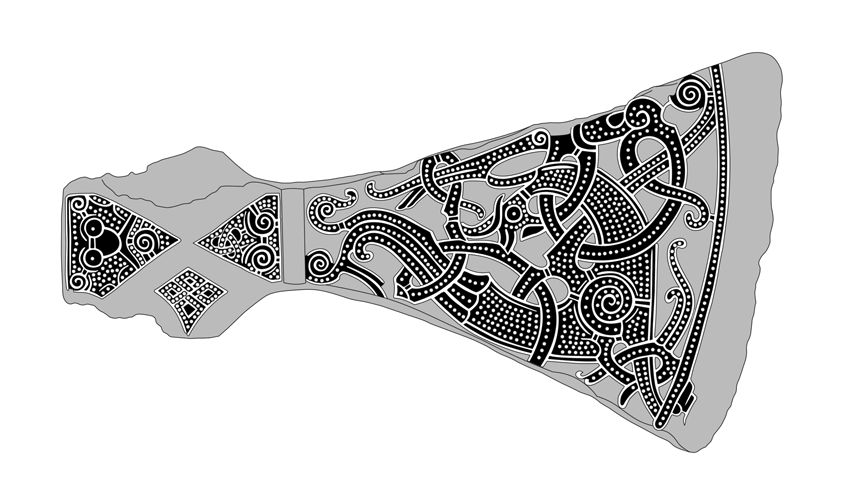
The Mammen Axe
An iron head inlaid with silver in the style it gave its name to. From the rich Bjerringhøj chamber-grave at Mammen, Jutland. Dendrochronology dates the burial to the winter of 970–971. A ceremonial magnate's axe, not a battlefield tool.
Drawing: Stefan Bollmann, CC BY-SA 3.0, via Wikimedia Commons. Artefact: Nationalmuseet, Denmark.
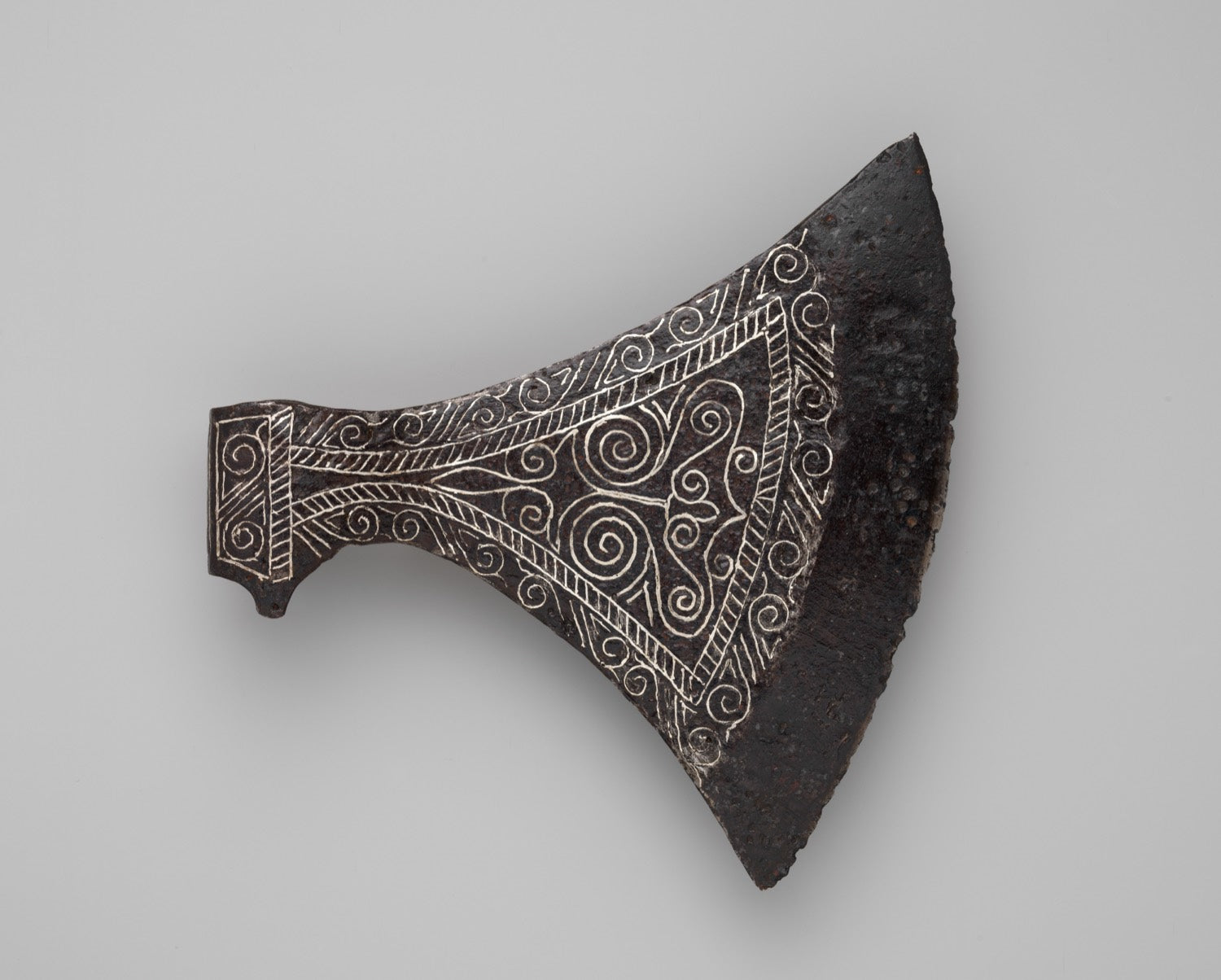
A surviving axe head
A genuine Scandinavian iron axe head. Centuries of corrosion have thinned it, but the single-bladed form and slender profile are unmistakable, nothing like the thick slabs of fantasy art.
Ax Head, Scandinavian, 11th–12th century. The Metropolitan Museum of Art (Open Access / CC0).

An axe in its grave
The Nordre Kjølen weapon grave from Solør, Norway: sword, spear, arrows and an iron axe head, buried together. Axes appear in graves far more often than swords, which is exactly why they define the age.
Photo: Wolfmann, CC BY-SA 4.0, via Wikimedia Commons. Artefacts: Museum of Cultural History, Oslo.
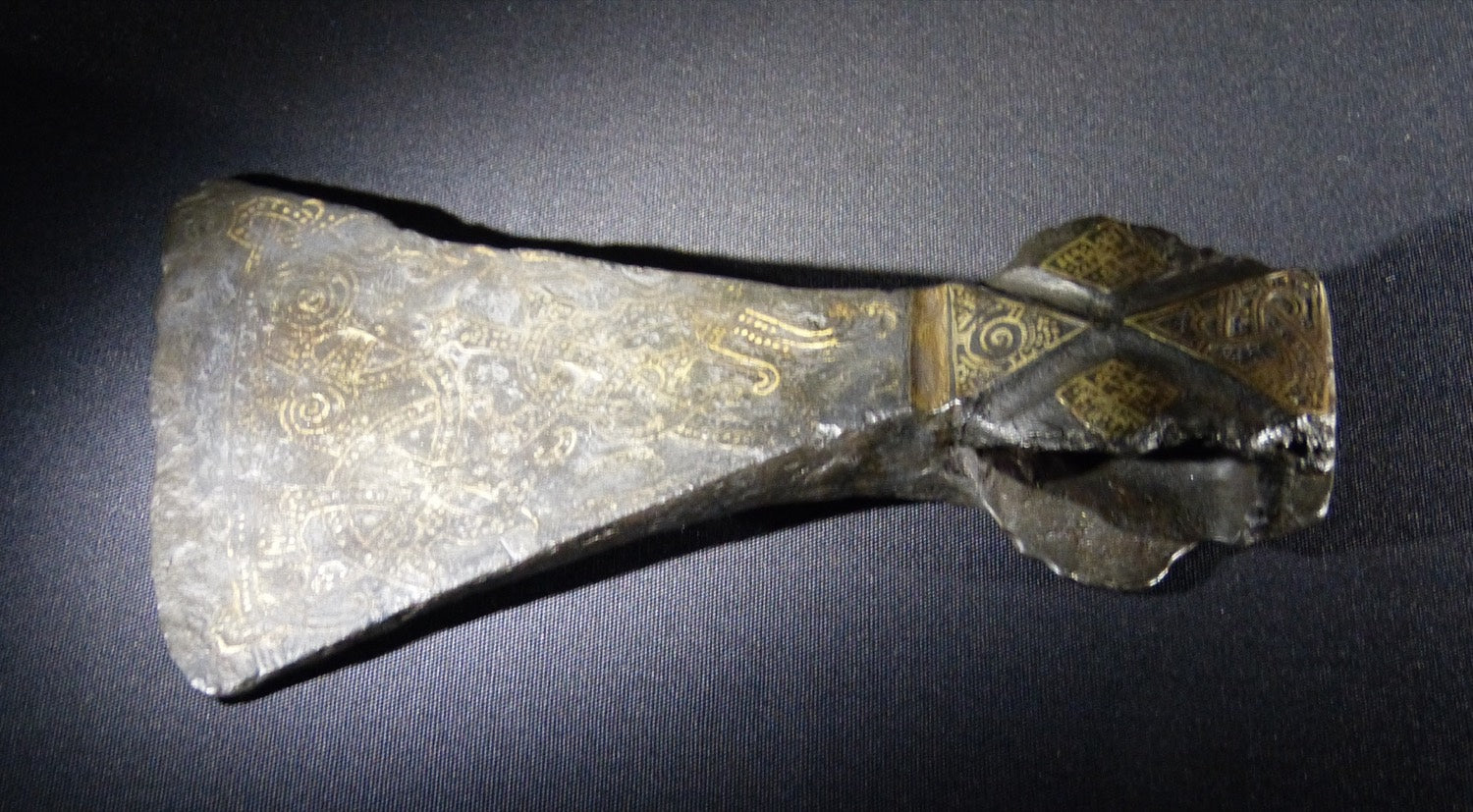
An ornamented late axe
A decorated, inlaid iron axe from the late Viking / early medieval Baltic world. Ornamented pieces exist, but even here the underlying shape is a normal functional axe; only the decoration is exceptional.
Photo: Wolfgang Sauber, CC BY-SA 4.0, via Wikimedia Commons. Archäologisches Landesmuseum Schwerin.
The Langeid broadaxe (Museum of Cultural History, Oslo; acc. C58882/4) deserves its own mention: a two-handed war axe from Setesdal, Norway, dated to the early 11th century, with a cutting edge just over 25 cm and a rare band of brass wrapped around its wooden haft. The brass's corrosion products preserved a stump of the original handle. It is the clearest surviving example of a purpose-built Viking battle axe.
Where they were found
The most important axe finds cluster across Viking-Age Scandinavia (Norway, Denmark and Sweden), with the two-handed war axe reaching Anglo-Norse England. The map below locates the sites named in this guide.

History vs fantasy
Much of the popular image of the Viking axe was invented long after the Viking Age. Here is where the evidence actually stands.
Vikings swung double-bladed "battle axes."
Real Viking axes were single-bladed. No surviving example, artwork or text supports a double-bitted Viking axe. The twin-bladed axe is a 19th-century North American forestry tool later borrowed by fantasy art.
Axe-wielding warriors wore horned helmets.
No horned Viking helmet has ever been excavated. The image was popularised by costume designs for Wagner's Ring cycle in 1876. Real helmets were plain iron caps, like the one from Gjermundbu.
Viking axes were huge, heavy cleavers.
They were light. Hand-axe heads ran a few hundred grams up to about a kilogram (the Langeid broadaxe ~800 g); even a big two-handed Dane axe was only ~1–2 kg, because the bit was thin. Power came from balance and a long haft, not mass.
The francisca is a Viking throwing axe.
The francisca is Frankish, characteristic of the Merovingian period (c. 500–750) and described by writers like Gregory of Tours, generations before the Viking Age. It belongs to Frankish, not Norse, material culture.
Axes in Norse myth and legend
The axe was a real-world weapon far more than a mythological one. In the surviving Norse myths the great weapons belong to the gods in other forms: Thor wields the hammer Mjölnir, and Odin the spear Gungnir. No major Norse god is an axe-god, and Thor carries no axe in the Eddas, although small axe-shaped amulets were worn in the Viking Age alongside Thor's-hammer pendants, and some scholars connect both to the cult of the thunder god.
The Leviathan Axe that many people now link with Norse mythology is not from the myths at all. It was created for the 2018 video game God of War and its sequel, a modern design inspired by Norse themes rather than an artefact or a story from the medieval sources.
Were Viking axes given names?
Usually not. Unlike prized swords, which were often named (Old Norse heroes carry blades such as Fótbítr, "leg-biter"), everyday axes were working tools and were rarely singled out with a name. The clearest exception is royal: the saga tradition records that King Magnus the Good carried a great axe he called Hel, after the goddess of the dead, said to have belonged to his father, Saint Olaf. Named axes are the rare exception, not the rule.
Viking axe tattoos and their meaning
As a tattoo, the Viking axe is a modern emblem rather than a documented ancient one. For wearers today it usually stands for strength, self-reliance and Norse heritage: the axe was the tool and weapon of the ordinary free person, so it reads as a symbol of the working warrior rather than of kings. It is often paired with runes, a Vegvísir stave, a wolf, or a bearded profile.
An honest note on the history: there is no evidence that Viking-Age people tattooed axes on their skin. The one near-contemporary account, the Arab traveller Ibn Fadlan's description of the Rus in the early 10th century, mentions dark figures and patterns "from fingernails to neck" but never says what they showed. A Viking axe tattoo today is a contemporary tribute to the culture, not a copy of a known original.
Carry the tradition
Our Viking axes are built on these historical forms, the bearded skeggøx and the broad Dane axe, as functional pieces and display arms. Explore the collection, or read deeper into the two great fighting forms.
Keep exploring Viking axes
- See how the two great fighting forms differ in Bearded Axe vs Dane Axe.
- What Is a Bearded Axe? explains the skeggøx and its beard in full.
- What Is a Dane Axe? tells the full story of the two-handed broad axe, its wielders, dimensions and famous finds.
- Viking Axe Throwing Guide covers technique, targets and safety, plus the francisca myth.
- The Best Viking Axes rounds up our hand-forged pieces built on these historical forms.
- The axe's edged sibling: What Is a Seax? covers the single-edged Norse knife-sword, or browse the Viking seax collection.
- Use the Rune Translator to write your name in authentic Norse runes for your axe or jewellery.
Frequently asked questions
What were the main types of Viking axe?
Two forms matter most: the bearded axe (skeggøx), an early dual-purpose tool and one-handed weapon whose lower edge is drawn into a "beard," and the wide two-handed broad axe (breiðøx), the purpose-built "Dane axe." Both sit within Jan Petersen's 1919 typology, which runs from Type A to M.
Did Vikings use double-bladed axes?
No. Every surviving Viking axe is single-bladed. There is no archaeological, artistic or written evidence for a double-bitted Viking axe. The twin-headed axe is a modern forestry tool later adopted by fantasy art and film, not a historical Norse weapon.
How heavy was a Viking axe?
Much lighter than most people expect. One-handed axe heads weighed roughly 0.5–1 kg, and even the large two-handed Dane axe was only about 1–2 kg because its blade was thin, often just 2–5 mm at the bit. Cutting power came from balance and haft length, not weight.
What is a bearded axe?
A bearded axe, or skeggøx, has its lower rear edge extended downward into a hook-like "beard" below the haft line. This adds cutting edge without adding weight and lets the hand grip close behind the blade. It appears early (8th–9th century) and served as both a woodworking tool and a weapon.
Is the francisca a Viking axe?
No. The francisca is a throwing axe of the Franks, typical of the Merovingian period (about 500–750 AD), before the Viking Age began in 793. It is often confused with Viking axes but belongs to Frankish, not Norse, culture.
Where can I see a real Viking axe?
The National Museum of Denmark holds the silver-inlaid Mammen axe; the Museum of Cultural History in Oslo holds the Langeid broadaxe and the Gjermundbu grave; and museums such as the Swedish History Museum and the Met display surviving axe heads. Many collections publish openly-licensed photographs online.
Did Vikings carry their axes on their back?
No. Viking axes were carried in the hand, thrust through a belt, or hung from a thong passed through the eye of the head. The back-mounted axe and the over-the-shoulder scabbard are conventions of film and video games, with no support in the archaeology or the written sources.
Does Thor have an axe in Norse mythology?
No. Thor's weapon is the hammer Mjölnir, and Odin's is the spear Gungnir; no major Norse god wields an axe. The "Leviathan Axe" often linked with Norse myth was created for the video game God of War in 2018 and does not appear in the medieval sources.
Were Viking axes given names?
Rarely. Prized swords were often named, but everyday axes were working tools and usually went unnamed. The best-known exception is the axe called Hel, carried by King Magnus the Good and said to have belonged to his father, Saint Olaf.
What does a Viking axe tattoo mean?
Today a Viking axe tattoo generally symbolises strength, self-reliance and Norse heritage, the axe being the tool and weapon of the ordinary free person. There is no evidence that Viking-Age people tattooed axes themselves, so it is a modern tribute rather than a historical design.
How can you tell if a Viking axe replica is historically accurate?
Check it against the archaeology on this page: a plausible replica is single-bladed, has a light, thin head (roughly 0.5–1 kg for a one-hander, with a bit only a few millimetres thick), matches one of the Petersen type shapes A–M, and hangs on a plain ash or oak haft. Red flags are double bits, spikes, heavy "chopper" heads over 1.5 kg on short hafts, and fantasy engravings presented as historical.
What is the difference between a sharpened and a blunt reenactment axe?
A sharpened (functional) axe has a real cutting edge and is meant for cutting, camp work or display. A blunt reenactment axe has the edge deliberately rounded to a few millimetres so it can be used in choreographed combat; most reenactment societies require blunted edges and inspect weapons before a show. The head shapes can be identical; the difference is only the edge.
How do you maintain a carbon steel axe head?
Keep it dry and lightly oiled: wipe the head after handling, apply a thin film of oil before storage, and deal with any rust spot early with fine steel wool and oil. Store it out of damp air and never long-term inside a leather cover, which traps moisture. Our full Viking axe care guide covers edge, handle and leather care step by step.
What were Viking axe handles made of?
Hafts were cut from tough hardwood, most often ash and sometimes oak, the same woods used for spears and ship parts. A one-handed axe took a haft of roughly 70–90 cm, while two-handed broad axes ran longer. Original hafts rarely survive, so lengths are reconstructed from grave finds and period images.
Are there legal restrictions on owning a Viking axe replica?
In most countries a replica axe is legal to own as a tool or collectible, but laws on carrying a blade in public, transporting it, and minimum buyer age differ by country, state and even city. Treat an axe like any other edged tool: keep it packed away in transit and check your local rules before buying or travelling with one. This is general information, not legal advice.
Sources & further reading
- Jan Petersen, De norske vikingesverd (Kristiania, 1919): the foundational axe typology.
- National Museum of Denmark: Axes and the Mammen grave.
- Museum of Cultural History, Oslo: The Langeid broadaxe.
- Hurstwic (W. R. Short) on Viking axe manufacture; Regia Anglorum on arms and armour; English Heritage on the weaponry of 1066.
Images are openly licensed (Public Domain / CC0 / CC BY-SA) with attribution shown per figure. Type illustrations, the anatomy diagram and the map are original VikingsBrand artwork.
Want the places behind the weapons? The battlefields, ring fortresses and grave sites in this guide, Mammen, Langeid, Stamford Bridge, are all plotted on our interactive Viking World Map, each with its own sourced story.