


Damascus Viking Seax Dagger – Bone Grip, 8" Blade
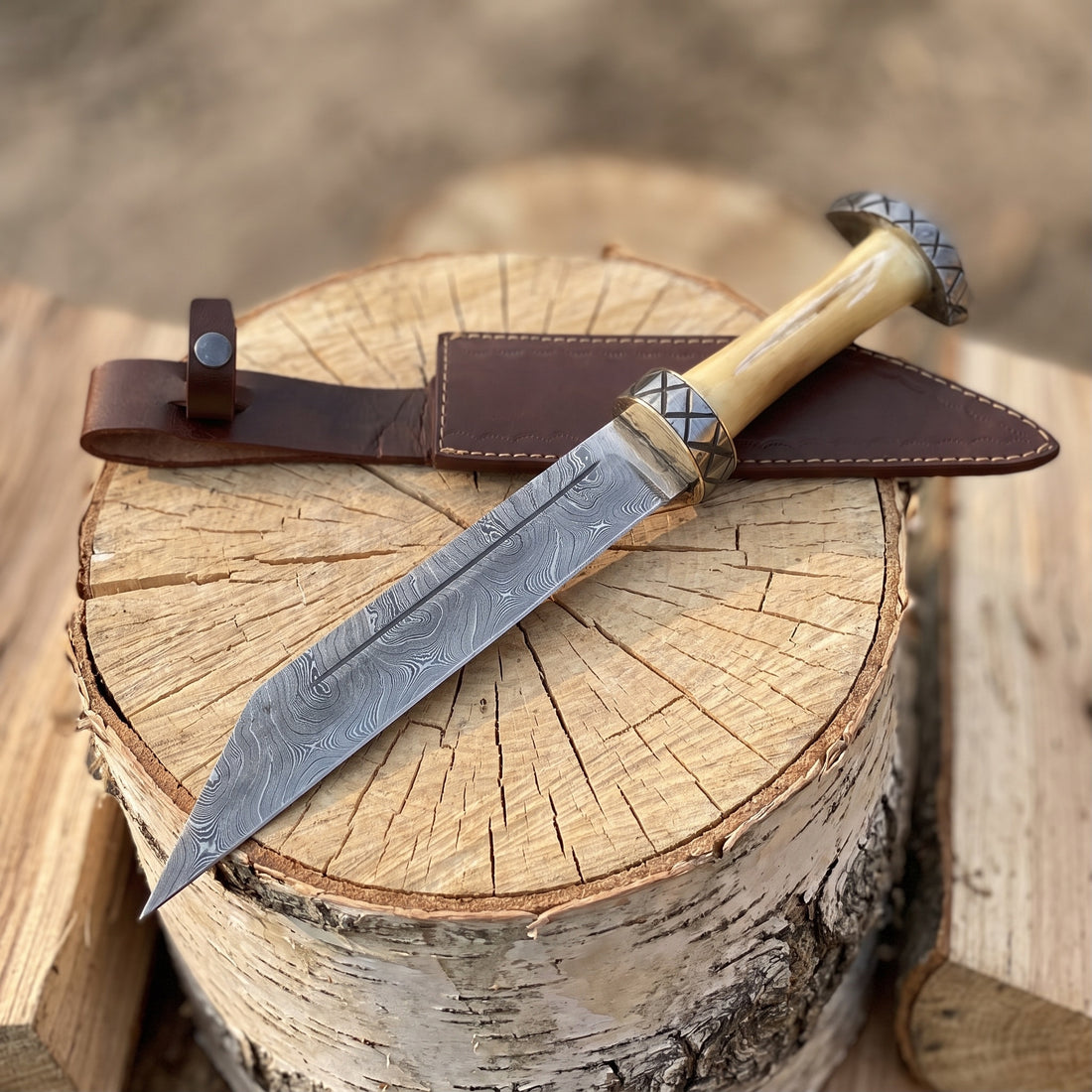
A hand-forged Viking seax dagger with an 8-inch Damascus steel blade, a genuine bone grip and a Damascus steel guard and pommel. It measures 13 inches overall, ships sharp in a tooled genuine leather belt sheath, and is sold as a hunting and collector's knife, not a kitchen knife.
 PREVIEW · Latin ·
Illustration only — final size and placement follow the blade you choose. See all personalized Viking blades.
What the pattern actually is
Steel sold as Damascus today is pattern-welded: layers of steel forge-welded together, folded, drawn out, then etched so the boundaries between the layers surface as light and dark bands. It is not the historical wootz crucible steel of Damascus, and we are not going to tell you it is. What it is instead is a technique the Norse genuinely used. Pattern-welded blades come out of Viking-Age graves, and the ripple running down this one is made the same way theirs was: steel welded to steel, with acid brought in at the end to show the seams.
The stock is given to us as 1075 high-carbon steel. That means it holds an edge, it sharpens on an ordinary stone, and it will spot with rust if you leave it wet. Carbon steel, with everything that follows from it.
The profile is a seax. The hilt is not.
The blade is single-edged. The spine runs level out of the guard, then falls away in one long clip to the point, with a narrow fuller cut just under the back. That is the seax silhouette, and it is what makes the knife read as Norse before you have looked at anything else on it.
The hilt is a different matter and worth being straight about. Excavated seaxes are usually bare: a tang through a wooden or horn grip, no guard, no pommel. This one has a Damascus collar at the blade, a thin brass spacer, a barrel of bone, and a crescent Damascus pommel, all of the steel cut with the same lozenge lattice. That is a maker's interpretation borrowing from Viking sword furniture, not a copy of a specific find. It is why the piece looks the way it does, and we would rather say so than let you assume a grave produced it.
Bone, and why no two are alike
The grip is a single piece of genuine bone, waisted through the middle so the hand sits where it should and swelling again before the pommel. Bone takes colour unevenly. Expect cream through to honey, with visible grain, darker flecks and the occasional natural mark, and expect your knife to differ from the photographs in exactly those ways. Every one is worked by hand.
The sheath
Genuine leather, dyed brown, stitched in contrasting thread with a scalloped border tooled along both edges. A riveted belt loop and a snap strap over the guard hold the knife where you put it. It is built to carry, not to sit on a shelf.
See the rest of the Viking seax collection, or start with our guide to what a seax actually is.
This is a hunting and collector's knife. It is not intended for kitchen or cooking use. Handle, store and carry it responsibly and in line with your local laws.


Every part earns its place
Where the numbers land: 8 inches of pattern-welded blade on a 13-inch dagger, a 5-inch bone grip held between a Damascus collar and a crescent Damascus pommel, both cut with the same lozenge lattice.


Carbon steel is alive — treat it so
High-carbon steel holds a keener edge than stainless, but it will spot with rust if left wet. Two minutes of care keeps this blade in the family for generations.

This is a working tool. It arrives sharp and can be re-sharpened like any carbon blade. Choose the Display edge if you want it purely for the wall — same steel, left unsharpened for safe handling.
Sold to adults 18+. A signature and ID may be required on delivery. Bladed goods can't ship to some regions — the cart flags restricted addresses at checkout. Full policy in our shipping guide.
Questions about this blade
Straight answers — the same ones we give over email.
Is this real Damascus steel?
It is pattern-welded steel, which is what the knife trade means by Damascus today: layers of steel forge-welded together and acid-etched so the pattern surfaces. It is not the historical wootz crucible steel of Damascus. Pattern-welding itself is a genuine Viking-Age technique, and this blade is made that way.
How big is the Damascus seax dagger?
The blade is 8 inches (203 mm) and the grip is 5 inches (127 mm), so the knife measures 13 inches (330 mm) overall.
What is the handle made of?
A single piece of genuine bone, set between a Damascus steel guard and a crescent Damascus steel pommel, with a thin brass spacer at the guard. Bone colours unevenly, so shade, grain and small natural marks vary from knife to knife.
Does it come with a sheath?
Yes. A tooled genuine leather belt sheath is included, with contrast stitching, a scalloped border, a riveted belt loop and a snap strap that closes over the guard.
Is the blade sharp, and how do I look after it?
It ships sharp. The steel is high-carbon rather than stainless, so wipe it dry after use, keep a light film of oil on it, and store it out of the leather for the long term so moisture is not held against the blade. A darker patina over time is normal.