
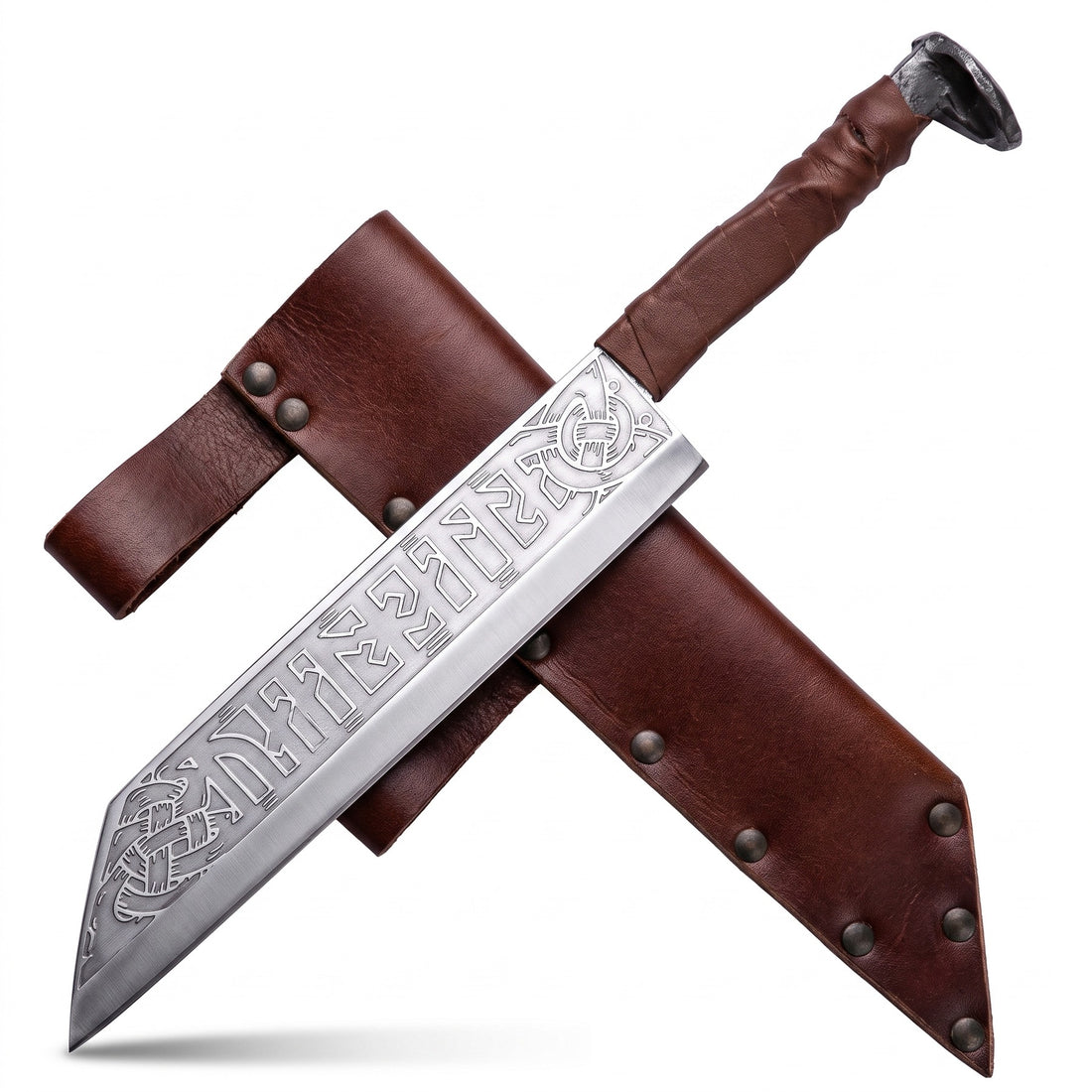


Langseax Viking Seax Knife – 13.5" Rune-Etched Blade
A hand-forged langseax — the longest form of the Viking seax — measuring 13.5 inches overall, with a runic band and Norse beast knotwork etched into a carbon steel blade, a leather-wrapped grip, a forged steel pommel and a hand-riveted leather sheath with dual belt loops. Sold as a hunting and collector's knife, not a kitchen knife.
 PREVIEW · Latin ·
Illustration only — final size and placement follow the blade you choose. See all personalized Viking blades.
This is a langseax
Seaxes run a long scale. At one end is a palm-length work knife; at the other is the langseax, long enough that graves containing them tend to contain no sword, because the langseax was the sword. That is where this one sits. The blade is broad through most of its length and carries a straight spine that turns down hard at the tip — mass forward, weight behind the cut. Pick it up expecting a knife and it will surprise you. If you want the full picture of the family, we wrote a guide to what a seax actually is.
The runes and the beast
The etching is the reason this one costs what it does. A band of angular runic characters runs the length of the blade, and at each end it resolves into a Norse beast — a gripping, coiling creature of the kind that runs across Urnes and Ringerike-style carving, all interlaced limbs and no clear beginning. It is etched into the steel rather than printed on it, so it catches light from the side and disappears when you turn the blade flat. Straight answer on the runes: they are decorative Elder Futhark characters, not a translated inscription, and we would rather tell you that than invent a saga line for them.
A pommel that was forged, not cast
The butt of this one is not a cast animal head like the smaller pieces in the range. It is a single lump of steel drawn out and flared into a broad T under the hammer, left with the tool marks still on it, then set against the leather. It gives the knife a real counterweight — the balance sits close to the hand instead of out at the tip — and it stops the grip dead. Different maker's answer to the same problem the raven pommels solve.
Two loops, not one
The sheath is thick leather closed with hammered rivets rather than stitching, and it carries two belt loops instead of one. Two loops let a long sheath sit flat against the hip instead of swinging off a single point, which matters a great deal more at thirteen inches than it does at five.
Who it's for
This is the piece for someone who already owns a belt knife and wants the thing at the top of the range — serious collectors, reenactors building a full kit, and display buyers who want the blade to be the object people ask about. It is worked by hand, so no two etchings sit identically.
See the rest of the Viking seax collection, or start smaller with the Boar's Head seax.
This is a hunting and collector's knife. It is not intended for kitchen or cooking use — handle, store and carry it responsibly and in line with your local laws.


Every part earns its place
Where the length goes: 13.5 inches overall, the etched band running the full reach of the blade before the leather-wrapped grip and the broad forged pommel that counterweights it.


Carbon steel is alive — treat it so
High-carbon steel holds a keener edge than stainless, but it will spot with rust if left wet. Two minutes of care keeps this blade in the family for generations.

This is a working tool. It arrives sharp and can be re-sharpened like any carbon blade. Choose the Display edge if you want it purely for the wall — same steel, left unsharpened for safe handling.
Sold to adults 18+. A signature and ID may be required on delivery. Bladed goods can't ship to some regions — the cart flags restricted addresses at checkout. Full policy in our shipping guide.
Questions about this blade
Straight answers — the same ones we give over email.
What is a langseax?
The longest form of the seax. Where a common belt seax runs four to six inches of blade, a langseax is long enough to serve as a primary weapon — in some Viking-age graves a langseax appears in place of a sword rather than alongside one. This one measures 13.5 inches overall.
What do the runes on the blade say?
Nothing. They are decorative Elder Futhark characters etched as a band, along with interlaced Norse beast-knotwork at each end of the blade. We do not sell it as a translated inscription, because it isn't one.
How big is the langseax?
It measures 13.5 inches (343 mm) overall, with a broad single-edged blade, a leather-wrapped grip and a forged steel pommel.
How does the sheath carry?
On a belt. The sheath is thick genuine leather closed with hammered rivets and fitted with two belt loops rather than one, so a sheath this long sits flat against the hip instead of swinging from a single point.
How do I look after the blade?
It is carbon steel, not stainless. Wipe it dry after handling, keep a light film of oil on it, and store it out of the sheath for the long term so moisture is not trapped against the steel. Take particular care around the etched band — the recessed lines hold moisture longer than the flats do.