
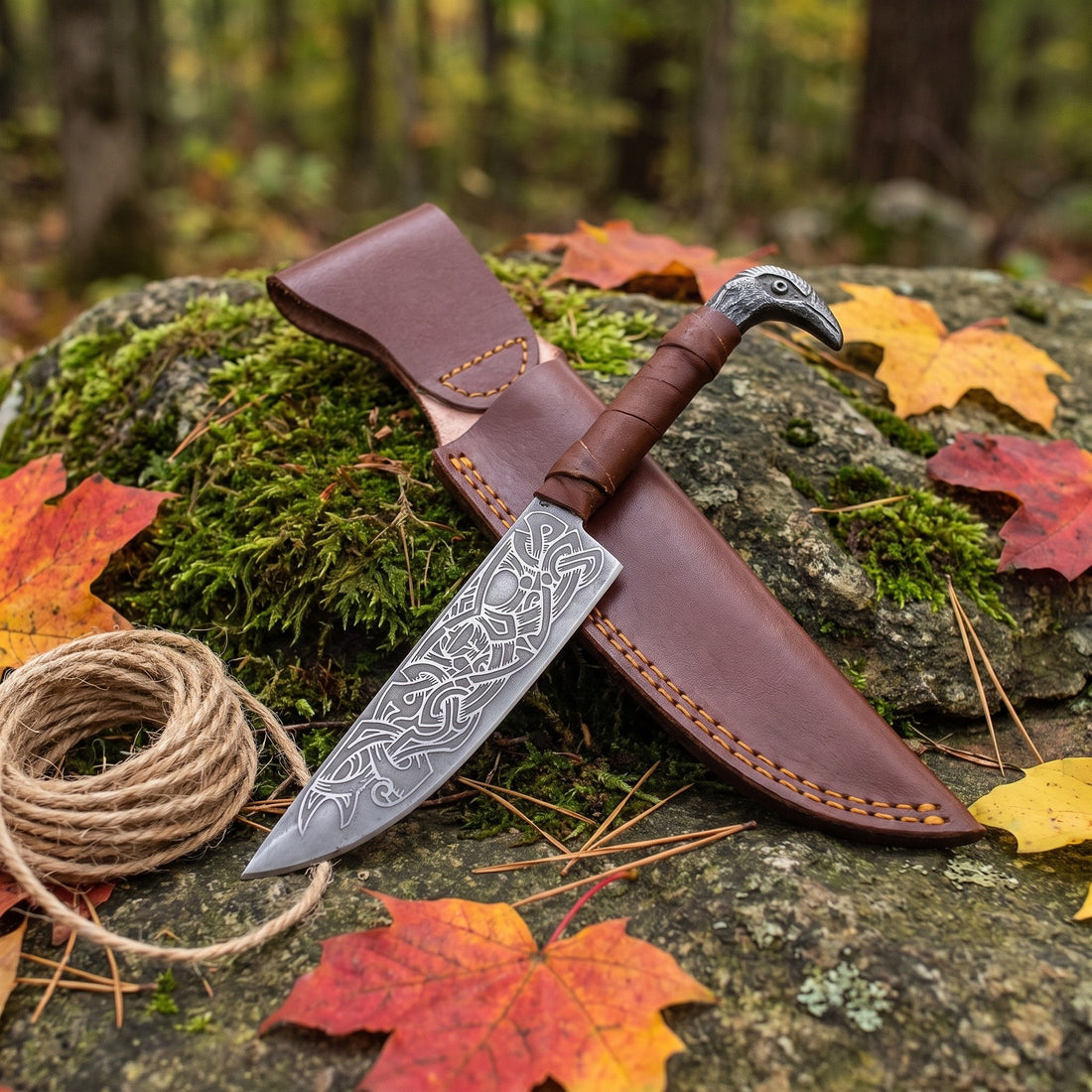


Raven-Hilt Viking Seax Knife – 5" Etched Carbon Steel
A hand-forged Viking seax knife with a 5-inch carbon steel blade acid-etched with interlaced ravens and Norse knotwork, a leather-wrapped grip and a cast raven's-head pommel. It measures 9.5 inches overall, comes with a fold-over genuine leather sheath, and is sold as a hunting and collector's knife, not a kitchen knife.
 PREVIEW · Latin ·
Illustration only — final size and placement follow the blade you choose. See all personalized Viking blades.
The raven, twice over
Most blades in the range make the raven once, at the pommel. This one makes it twice. The cast head hooks back off the butt of the grip where your hand ends, and then the bird returns on the flat of the blade — wings and beak worked into a band of interlace that runs from the ricasso almost to the point, so the two ravens face each other down the length of the knife. Turn it in the light and the etched one appears and vanishes; the cast one never moves.
Etched, not printed
This matters more than it sounds. The pattern is bitten into the steel with acid, which means it sits below the surface rather than on top of it. A laser mark or a print is a film that wears through at the high spots on a blade you actually handle; an etch is a depth. It will darken as the steel patinas and it will still be legible after the flats have gone grey. You can feel it with a thumbnail.
What the design is
Interlaced beasts and ribbon-work in the manner of Borre and Jelling-style Norse ornament — the gripping, biting animals that wrap around each other with no clear start or finish, the same visual logic that runs across Viking-age brooches, sledge posts and stone. Straight answer: it is ornament in that tradition, not a copy of one specific surviving object and not a scene from a named saga.
Who it's for
Anyone who wants the decoration to be the reason they bought it — collectors, gift buyers, and reenactors who want a belt knife with real surface work rather than a plain blade. Each is etched by hand, so the bite of the acid and the darkness of the lines differ slightly from piece to piece.
New to the form? Read our guide to what a seax actually is. Or browse the full Viking seax collection — including the ash-handled Huginn & Muninn seax and the plain-bladed Boar's Head seax.
This is a hunting and collector's knife. It is not intended for kitchen or cooking use — handle, store and carry it responsibly and in line with your local laws.


Every part earns its place
Where the numbers land: 5 inches of etched single edge on a 9.5-inch knife, the leather-wrapped grip running back to the cast raven's head that closes the hand.


Carbon steel is alive — treat it so
High-carbon steel holds a keener edge than stainless, but it will spot with rust if left wet. Two minutes of care keeps this blade in the family for generations.

This is a working tool. It arrives sharp and can be re-sharpened like any carbon blade. Choose the Display edge if you want it purely for the wall — same steel, left unsharpened for safe handling.
Sold to adults 18+. A signature and ID may be required on delivery. Bladed goods can't ship to some regions — the cart flags restricted addresses at checkout. Full policy in our shipping guide.
Reviews 5.0 · 1
WRITE A REVIEWQuestions about this blade
Straight answers — the same ones we give over email.
How big is the Raven-Hilt seax knife?
The blade is 5 inches (127 mm) and the knife measures 9.5 inches (241 mm) overall.
Is the pattern etched or printed on?
Etched. It is bitten into the steel with acid, so the lines sit below the surface and can be felt with a thumbnail. Unlike a printed or laser-marked finish it will not wear off the high spots with handling.
What does the design on the blade show?
Interlaced ravens and ribbon-work in the manner of Borre and Jelling-style Norse ornament — gripping beasts wound around each other. It is decoration in that tradition rather than a reproduction of one specific archaeological find.
How is this different from the Huginn & Muninn seax?
Different handle and different blade. This one has a leather-wrapped grip finished with a cast raven's-head pommel and a 5-inch blade; the Huginn & Muninn seax has an ash-wood handle and a 4.7-inch blade. Both carry raven etching, but the hilts are not comparable.
Does carbon steel need special care?
A little. It is not stainless, so wipe it dry after handling and keep a light film of oil on it. Store it out of the sheath for the long term. The etched lines hold moisture longer than the flats, so dry them properly — a darkening patina over time is normal and does not harm the blade.