
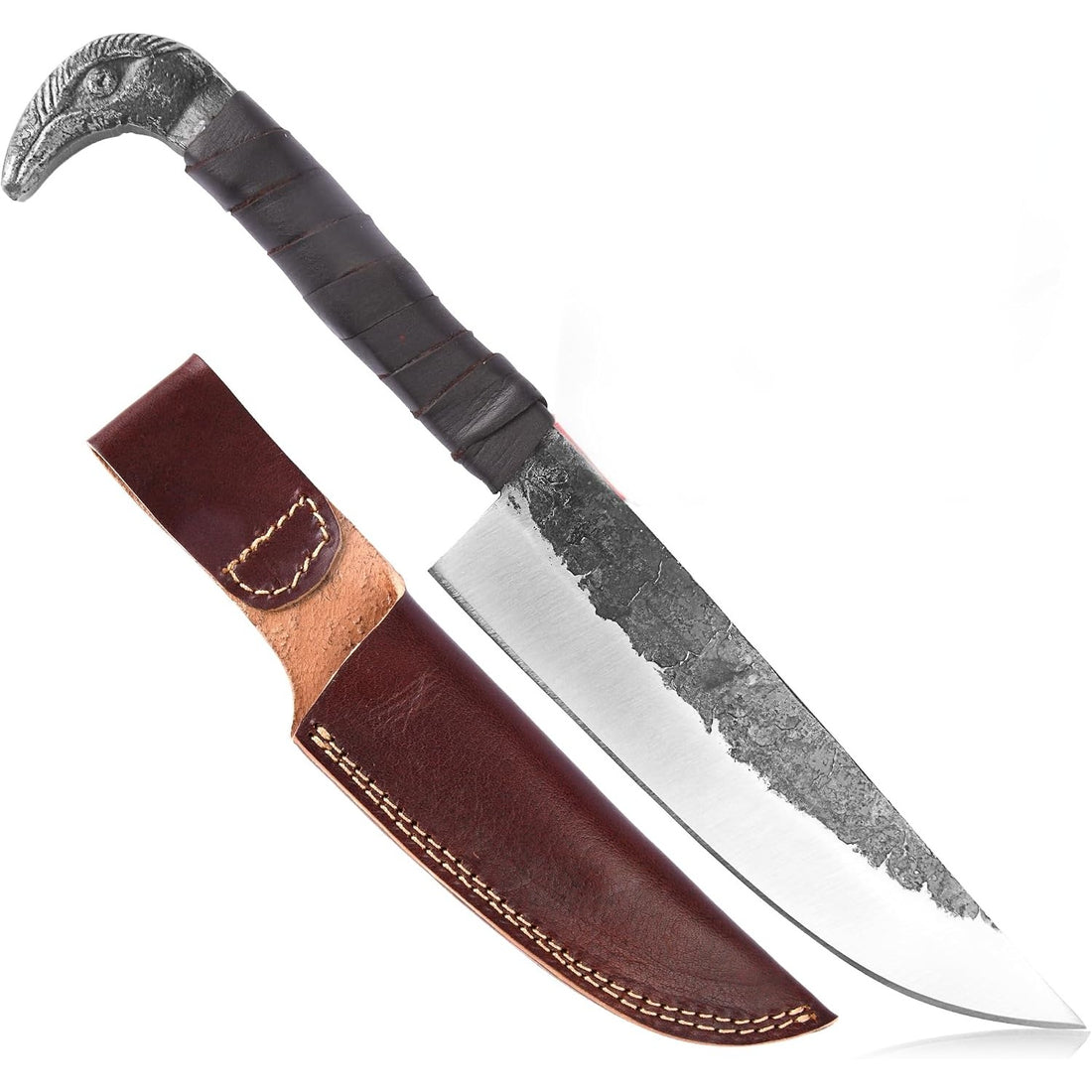


Raven's Beak Viking Seax Knife – Hand-Forged 5.5" Blade
A hand-forged Viking seax knife with a 5.5-inch carbon steel blade, a leather-wrapped grip and a cast raven's-head pommel, carried in a stitched cowhide leather sheath. It measures 9.5 inches overall and is sold as a hunting and collector's knife, not a kitchen knife.
 PREVIEW · Latin ·
Illustration only — final size and placement follow the blade you choose. See all personalized Viking blades.
The beak is a hand-stop
Look at where the raven's head sits. The beak hooks down and back, so the heel of your hand runs into it before your grip can run off the end. A seax has no crossguard and no finger choil; on a single-edged belt knife the pommel is the only thing standing between your fist and the edge. A hooked butt is one answer to that, and a bird's head is that answer wearing a face. Hold it once and the difference between decoration and shape that does a job stops being theoretical.
Where the forge skin stops
Run your eye down the flat. There is a hard, wandering line where the dark pitted forge skin gives way to bright ground steel, the boundary the smith left behind when the bevel was taken back by hand instead of blasted flat by a machine. It wanders because a hammer wanders. On two knives off the same anvil that line falls differently, which is the honest signature of a piece worked one at a time. The marks along the spine are from the same afternoon.
The raven the Norse actually followed
Ravens in Norse thought are not only Odin's two counsellors. They were the birds that gathered where armies had been, which is how the raven became a banner rather than a pet: the Hrafnsmerki, the raven standard, flown by Danish and Norwegian war-bands, and later sources name the banner captured from a Norse force in Devon in 878 as the Raven. To put a raven at the end of a blade is to fly a very small version of that standard.
Who it's for
People who want a Norse blade in the hand rather than on a shelf: collectors, reenactors after the right silhouette on a belt, and anyone buying a gift that arrives with something to say. Every one is worked by hand, so hammer texture, forge colour and small differences between pieces are part of the deal rather than a flaw in it.
If you want the background on the form itself, we wrote a guide to what a seax actually is. Browse the rest of the Viking seax collection, step up to the longer Odin's Raven seax, or down to the compact Boar's Head seax.
This is a hunting and collector's knife. It is not intended for kitchen or cooking use, handle, store and carry it responsibly and in line with your local laws.


Every part earns its place
Where the numbers land: 5.5 inches of single edge on a 9.5-inch knife, with the leather-wrapped grip running back to the hooked raven's-head pommel that stops the hand.


Carbon steel is alive — treat it so
High-carbon steel holds a keener edge than stainless, but it will spot with rust if left wet. Two minutes of care keeps this blade in the family for generations.

This is a working tool. It arrives sharp and can be re-sharpened like any carbon blade. Choose the Display edge if you want it purely for the wall — same steel, left unsharpened for safe handling.
Sold to adults 18+. A signature and ID may be required on delivery. Bladed goods can't ship to some regions — the cart flags restricted addresses at checkout. Full policy in our shipping guide.
Questions about this blade
Straight answers — the same ones we give over email.
How big is the Raven's Beak seax knife?
The blade is 5.5 inches (140 mm) and the knife measures 9.5 inches (241 mm) overall.
What is the hooked pommel for?
It works as a hand-stop. A seax has no crossguard, so the raven's beak curls back over the heel of your hand and keeps your grip from sliding forward onto the edge. It also gives the knife something to hang on.
Why is the raven a Norse symbol?
Two reasons that overlap. Odin kept the ravens Huginn and Muninn, who flew out over the world each day and brought back what they had seen. Ravens also followed armies, which is how the bird ended up on the Hrafnsmerki, the raven war banner carried by Norse forces in Britain and Ireland.
How is this different from the larger Odin's Raven seax?
Same family, different size and pommel casting. This one is 9.5 inches overall with a 5.5-inch blade; the Odin's Raven seax is 10.3 inches with a 6.5-inch blade. Take this one if you want a knife that carries easily, the larger one if you want more presence in a display.
Can I use it for camping and hunting?
It is sold as a hunting and collector's knife, and carbon steel handles ordinary outdoor cutting well. It is not a kitchen knife. Because the steel is not stainless, wipe it dry after use and keep a light film of oil on it, especially if it has been out in the wet.