
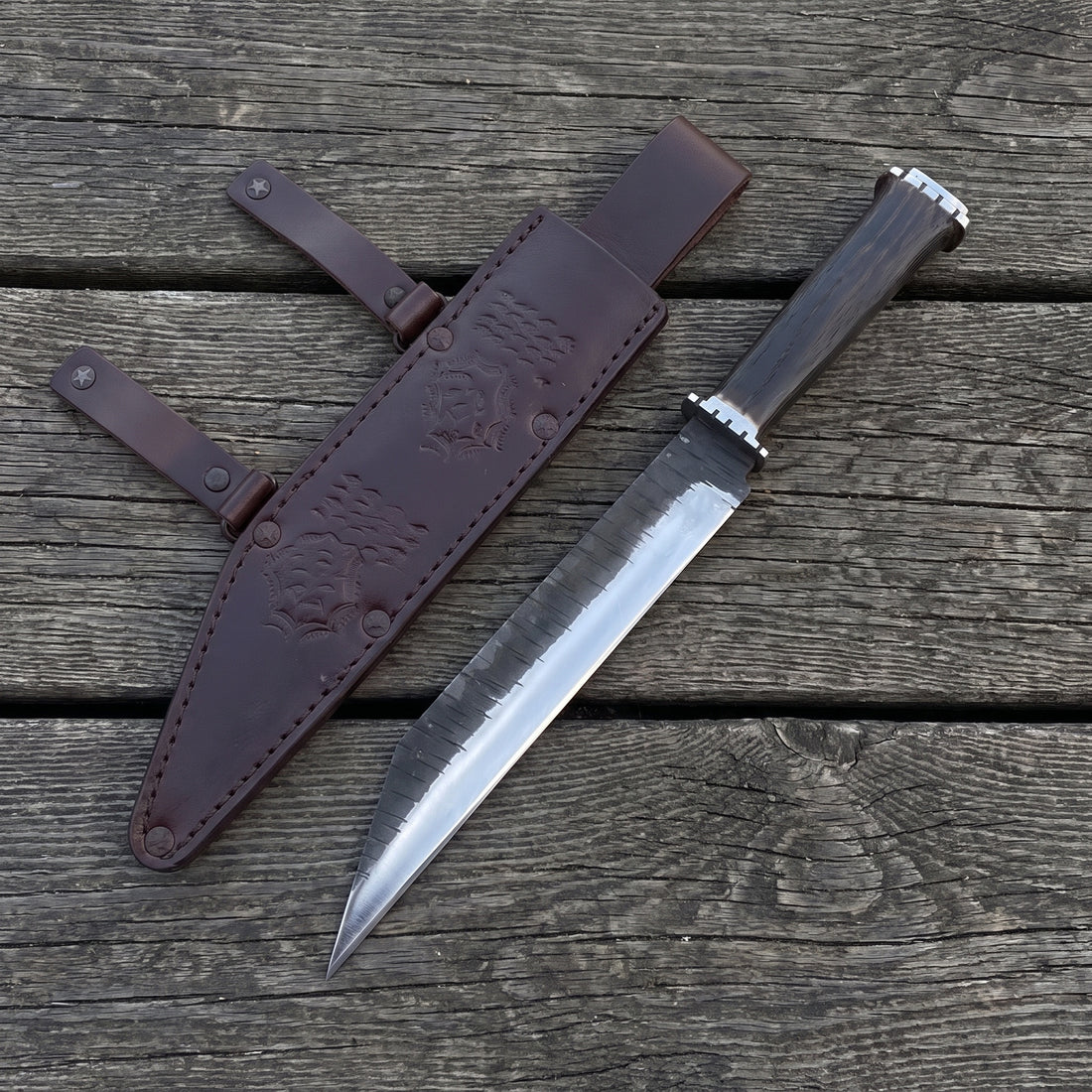


Viking Seax Knife – 12" Blade, Forge-Finished Steel
A hand-forged Viking seax knife with a 12-inch 1075 high-carbon blade, a rosewood handle and plain metal fittings. It measures 17 inches overall, ships sharp with a hand-stitched cowhide leather sheath, and both the blade flat and the handle can be engraved to order.
 PREVIEW · Latin ·
Illustration only — final size and placement follow the blade you choose. See all personalized Viking blades.
Twelve inches is the large end of the form
Most excavated seaxes are short. The everyday ones run four to eight inches of blade, and only the largest, the langseax, gets past a foot. At 12 inches of blade and 17 overall this sits at the top of that range, closer to a short sword in the hand than to a belt knife. It is worth knowing before you buy: this is not a pocketable working seax, it is a statement piece with real reach.
The two-tone finish, and what it is
The blade reads as two clean bands. The flat along the spine is left dark from the forge and carries a run of short file marks across it; the lower half is ground and polished bright to the edge. The line between them is straight and deliberate.
We would rather be plain about this: that dark band is a finish, not a structural feature, and the file marks are texture rather than evidence of anything. What they do is stop a 12-inch slab of steel reading as flat and dead, and they hide handling marks the way a mirror polish never will. It is a good-looking, practical choice, and that is the whole claim.
1075, and what it costs you
1075 is plain high-carbon steel: iron and about three quarters of one percent carbon, no chromium. It hardens predictably, takes a fine edge and sharpens back on an ordinary stone. It also rusts. On a blade this size that matters more than usual, because there is more surface to look after. Wipe it dry, keep a film of oil on it, and store it out of the leather.
Rosewood and metal
The handle is rosewood, a dense oily hardwood that resists moisture and takes a soft satin sheen rather than a plastic shine. It runs deep reddish-brown with darker striping, different on every piece. A plain metal collar sits where the blade meets the handle and a matching cap closes the butt, both smooth and undecorated, with fine ribbing and honest working scuffs.
Make it yours
Both the blade flat and the rosewood handle can be engraved. A name, a date, a short line in runes. Engraving is hand-etched to order and adds a few days to dispatch. Choose it in the configurator above.
The sheath
Hand-stitched cowhide, dyed dark brown, with a pressed decorative panel on the face, a riveted belt loop and a strap that studs shut over the handle.
See the rest of the Viking seax collection, or start with our guide to what a seax actually is.
Sold to adults 18 and over. This is a hunting and collector's knife, not a kitchen knife. Handle, store and carry it responsibly and in line with your local laws.


Every part earns its place
Where the numbers land: 12 inches of blade on a 17-inch knife, about 38 mm wide and 4 mm thick, with a 5-inch rosewood handle between a plain metal collar and a matching metal cap.


Carbon steel is alive — treat it so
High-carbon steel holds a keener edge than stainless, but it will spot with rust if left wet. Two minutes of care keeps this blade in the family for generations.

This is a working tool. It arrives sharp and can be re-sharpened like any carbon blade. Choose the Display edge if you want it purely for the wall — same steel, left unsharpened for safe handling.
Sold to adults 18+. A signature and ID may be required on delivery. Bladed goods can't ship to some regions — the cart flags restricted addresses at checkout. Full policy in our shipping guide.
Questions about this blade
Straight answers — the same ones we give over email.
How big is this Viking seax knife?
The blade is 12 inches (305 mm) and the handle is 5 inches (127 mm), so the knife measures 17 inches (432 mm) overall. The blade is about 38 mm wide and 4 mm thick.
What steel is the blade?
Hand-forged 1075 high-carbon steel. It is not stainless, so it takes a fine edge and sharpens easily, but it will spot if left wet and will darken to a patina over time.
Why is the blade two different colours?
The flat along the spine is left dark from the forge and carries a run of file marks, and the lower half is ground and polished bright to the edge. It is a finish rather than a structural feature, and it hides handling marks better than a full mirror polish.
What is the handle made of?
Rosewood, with a plain metal collar at the blade and a matching plain metal cap at the butt. Rosewood is dense and oily, so it handles moisture well, and its grain and colour vary from piece to piece.
Can it be engraved?
Yes. Both the blade flat and the rosewood handle can be engraved to order, hand-etched. Engraving adds a few days to dispatch.