
Fehu Rune Meaning: Wealth, Cattle and the ᚠ Rune Explained


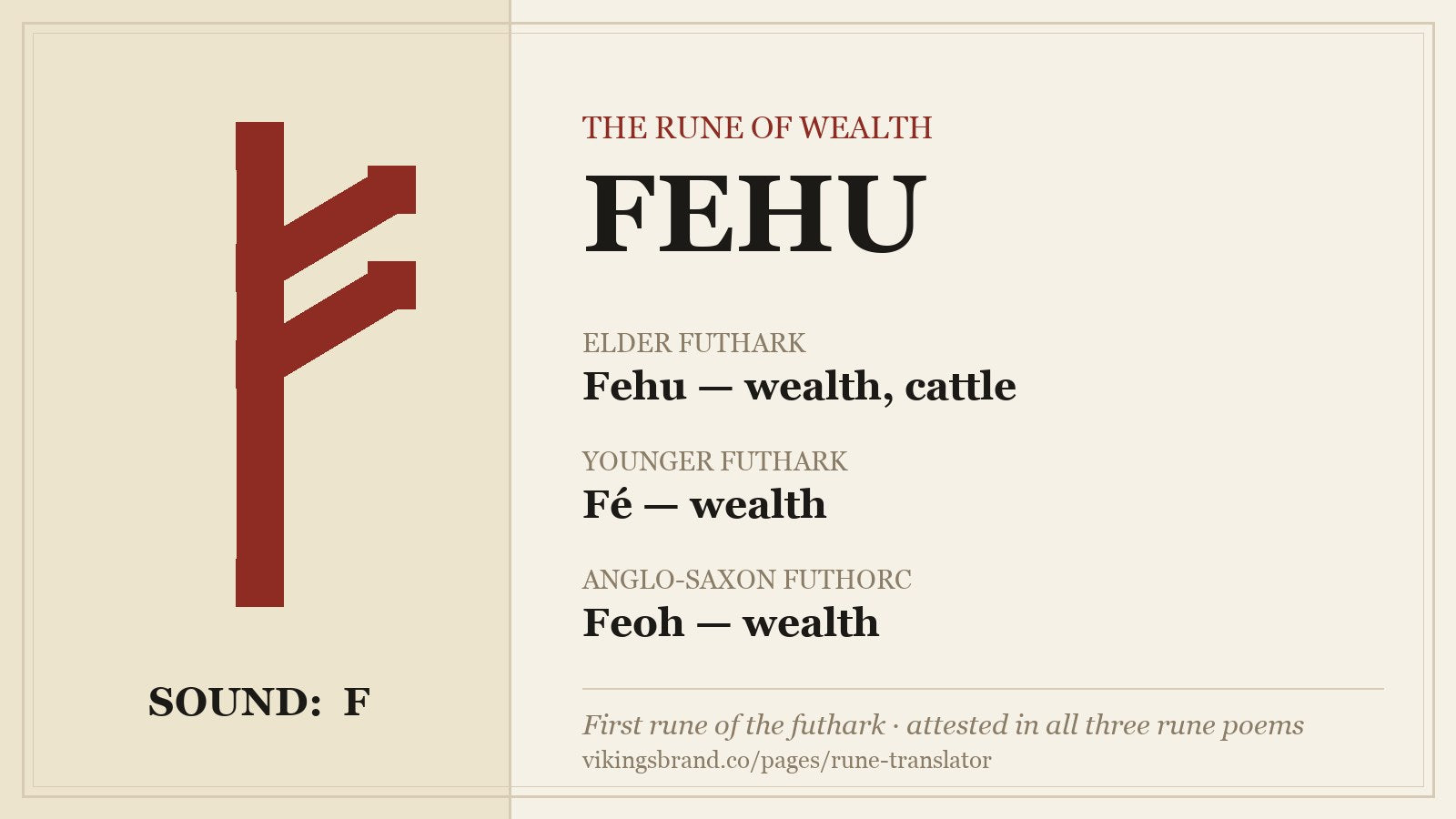
Fehu (ᚠ) is the first rune of the Elder Futhark and it means "wealth": literally "cattle", the movable wealth of the early Germanic world. It carries the sound f, opens the rune row (which is why the alphabet is called the fu-th-ark), and appears in all three historical futharks: as Fehu in the Elder Futhark, Fé in the Viking-Age Younger Futhark, and Feoh in the Anglo-Saxon Futhorc.
ᚠ
What does Fehu mean?
The name goes back to a Proto-Germanic word for cattle, the same root that survives in the English word fee. In a world before coined money reached the North, herds were wealth you could move, trade and gift. So Fehu came to stand for wealth in the broad sense: property, prosperity, and the responsibilities that come with them.
We don't have to guess at how medieval people understood this rune, because three rune poems survive (one Norwegian, one Icelandic, one Old English), and each has a verse for it.
Fehu in the three rune poems
Fé vældr frænda róge; føðesk ulfr í skóge.
"Wealth breeds discord among kin, and the wolf is reared in the wild wood." (Norwegian Rune Poem, c. 13th century)
Fé er frænda róg / ok flæðar viti / ok grafseiðs gata.
"Wealth sows strife among kinsmen; it is the flame of the sea and the serpent's path." (Icelandic Rune Poem, c. 15th century)
Feoh byþ frofur fira gehwylcum; sceal ðeah manna gehwylc miclun hyt dælan gif he wile for drihtne domes hleotan.
"Wealth is a comfort to all, yet each must give of it freely if he would win the Lord's esteem." (Old English Rune Poem, c. 8th–9th century)
Notice how consistent the message is across three countries and several centuries: wealth is good, but it divides families and must be shared. That nuance (prosperity with a warning attached) is the authentic, attested meaning of Fehu, and it is considerably richer than the "money luck" shorthand you often see online.
How to write Fehu
Fehu stands for the sound f. Any name or word with an F in it will contain ᚠ when transliterated. Try it yourself in our free rune translator, which writes your name in the Elder, Younger or Anglo-Saxon rows and lets you download it as a poster. The full texts of all three rune poems, with our translations, are on the same page.
Fehu, trade and the Viking world
Wealth in the Viking Age moved along rivers and sea lanes: Arabic silver flowed north along the Volga to towns like Birka and Hedeby in exchange for furs and amber. You can trace that entire silver road (every stop cited to a museum or academic source) on our interactive Viking world map.
Keep exploring: Fehu opens the rune row. See all 24 letters decoded in our Elder Futhark rune meanings guide, then meet its neighbour Uruz, the aurochs rune, or contrast movable wealth with the inherited kind in Othala, the rune of heritage.
Where Fehu sits in the row: Uruz follows. Rune 1 of 24 in the Elder Futhark.
Fehu FAQ
Is Fehu a lucky rune?
Historically it is the rune of wealth and prosperity, but every surviving rune poem pairs that wealth with a warning about greed and strife. If you wear it, the attested meaning is closer to "prosperity, handled wisely" than to simple luck.
What letter does Fehu represent?
The letter F. It is the first rune of all three futhark rows.
What is the difference between Fehu, Fé and Feoh?
They are the same rune in three traditions: Fehu is the reconstructed Elder Futhark name, Fé is the Old Norse name in the Younger Futhark used on Viking runestones, and Feoh is the Old English name in the Anglo-Saxon Futhorc.
Can I get Fehu on jewelry?
Yes, runic inscriptions appear across our Viking rune jewelry, and several pieces can be personalised with your own runes.