
Viking Last Names: Why the Norse Had No Surnames


Vikings did not have last names. They had a given name and a patronymic, and a patronymic is not a surname. It names your father, not your family, so it changes with every generation and it is different for a brother and a sister in the same house.
Eiríkr Þorvaldsson is Eirik, son of Thorvald. His daughter is Freydís Eiríksdóttir, Freydis, daughter of Eirik. Nothing is inherited. Nothing is shared.
Build a full Norse name with a byname, or read on for the full lists.

How the Patronymic Forms
Take the father's name, put it in the genitive case, then add -son or -dóttir. The genitive is the part people get wrong.
| Father | Genitive | Son | Daughter |
|---|---|---|---|
| Björn | Bjarnar | Bjarnarson | Bjarnardóttir |
| Þórr | Þórs | Þórsson | Þórsdóttir |
| Sigurðr | Sigurðar | Sigurðarson | Sigurðardóttir |
| Óláfr | Óláfs | Óláfsson | Óláfsdóttir |
| Ketill | Ketils | Ketilsson | Ketilsdóttir |
| Grímr | Gríms | Grímsson | Grímsdóttir |
| Hákon | Hákonar | Hákonarson | Hákonardóttir |
| Magnús | Magnúss | Magnússon | Magnúsdóttir |
Notice that Björn becomes Bjarnar, not Björns. The vowel changes. Any tool that simply appends -son to the nominative produces broken Old Norse, which is why our name generator uses a curated genitive table rather than computing it.
Given Names You Would Actually Be Named After
A patronymic is only as real as the name it is built from. These are attested masculine given names, each with its meaning and source.
| Name | Meaning | Attested in |
|---|---|---|
| Óláfr | ancestor's descendant | Landnámabók |
| Þórsteinn | Þórr's stone | Landnámabók |
| Þórgeirr | Þórr's spear | Landnámabók |
| Þórvaldr | Þórr's ruler | Landnámabók |
| Þórbjörn | Þórr's bear | Landnámabók |
| Þórfinnr | Þórr's Finn | Landnámabók |
| Þórgrímr | Þórr's mask | Landnámabók |
| Þórkell | Þórr's helmet | Landnámabók |
| Þóroddr | Þórr's spear-point | Landnámabók |
| Þórarinn | Þórr's hearth | Landnámabók |
| Þórir | of Þórr | Landnámabók |
| Björn | bear | Landnámabók |
| Sigurðr | victory-guardian | Völsunga saga |
| Haraldr | army-ruler | Heimskringla |
| Hákon | high son | Heimskringla |
| Eiríkr | ever-ruler | Heimskringla |
| Ívarr | yew-warrior | Heimskringla |
| Ketill | helmet, cauldron | Landnámabók |
| Grímr | mask, helm | Landnámabók |
| Gunnarr | battle-warrior | Njáls saga |
| Egill | edge, blade | Egils saga |
| Njáll | champion (Gaelic loan) | Njáls saga |
| Kári | curly-haired; squall | Njáls saga |
| Skarphéðinn | sharp fur-cloak | Njáls saga |
| Höskuldr | grey-haired | Laxdæla saga |
| Hrútr | ram | Njáls saga |
| Flosi | chieftain | Njáls saga |
| Ásgrímr | god-mask | Njáls saga |
| Snorri | attack, onslaught | Eyrbyggja saga |
| Arnkell | eagle-helmet | Eyrbyggja saga |
| Steinþórr | stone-Þórr | Eyrbyggja saga |
| Illugi | of ill mind | Grettis saga |
| Ásmundr | god-protection | Grettis saga |
| Grettir | the snarler | Grettis saga |
| Atli | little father | Njáls saga |
| Önundr | the winner | Grettis saga |
| Gísli | hostage, pledge | Gísla saga |
| Vésteinn | sacred stone | Gísla saga |
| Bárðr | battle-warrior | Landnámabók |
| Auðunn | wealth-friend | Landnámabók |
| Hallr | rock | Landnámabók |
| Sturla | the unruly | Sturlunga saga |
221 more attested names are in the name generator, each with its meaning and source.

What Filled the Gap Instead of Surnames
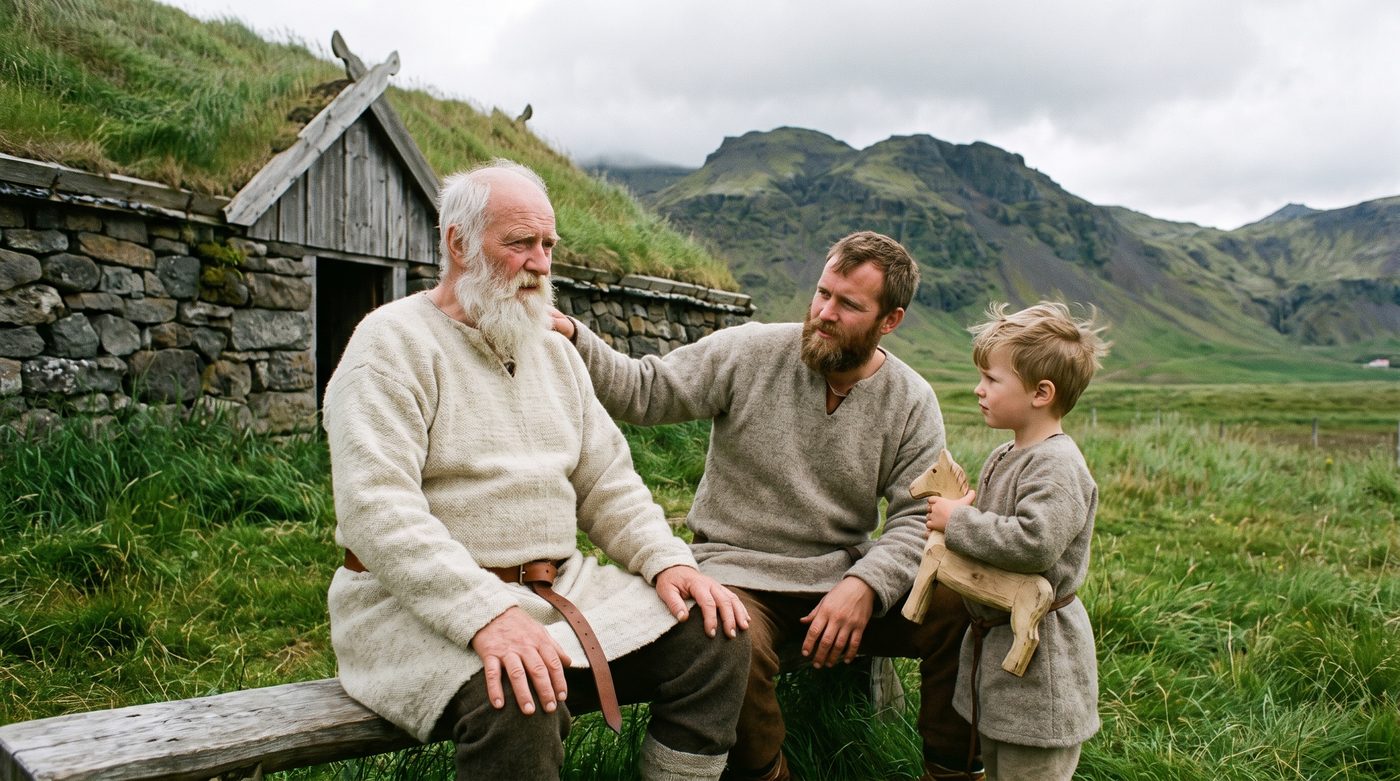
Three things did the work a family name does now.
The byname. A descriptive nickname, covered in full in our guide to Viking bynames. This is what actually distinguished people day to day.
The farm or district. People were placed by where they lived, as in Hvamm-Þórir, the Þórir from Hvammr.
Descent from a notable ancestor. A kin group could be spoken of collectively through the person they came from, without that name being inherited by anyone as a surname.
When Surnames Arrived
Fixed surnames spread through Scandinavia between roughly 1500 and 1900, and the frozen patronymics are the reason Nordic surnames look the way they do now. Every Andersson, Nilsen, Larsen and Jonsdóttir is a patronymic that stopped changing. Iceland never adopted the change and still runs on patronymics today.
Wear the Name
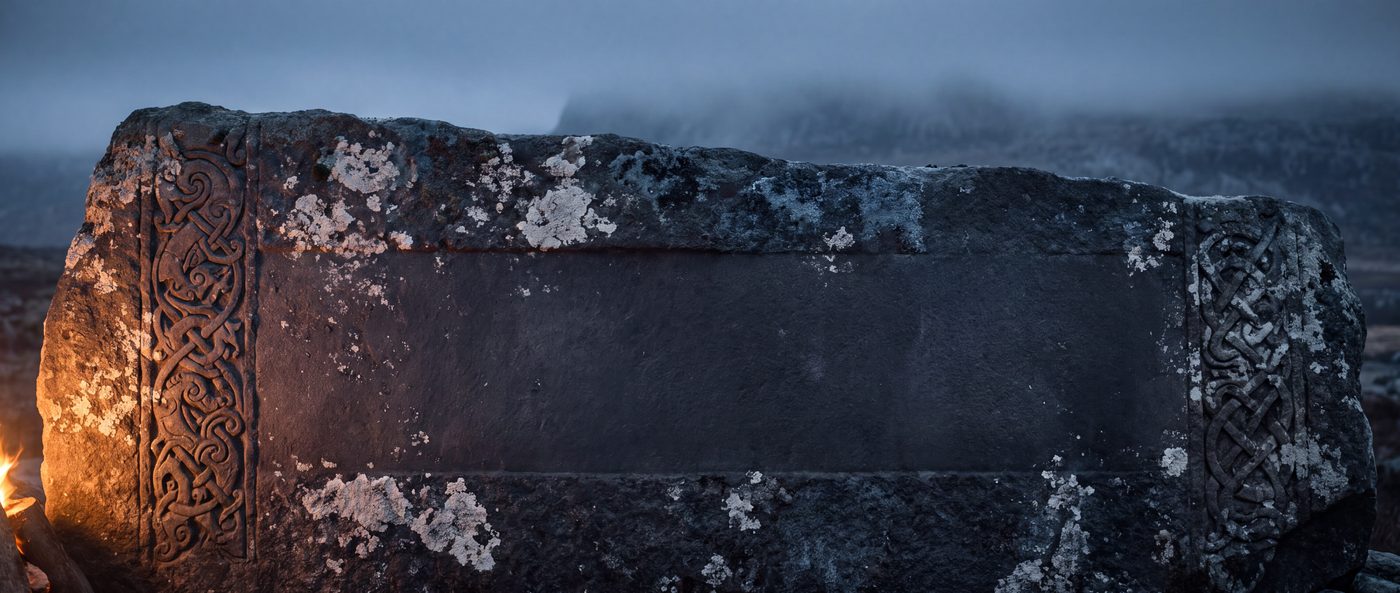
If you want your own name and patronymic in Younger Futhark, our rune translator will set it, and we engrave it on hand-forged blades.
Patronymics are one half of the story; the given name is the other. See the full Norse naming system for both.
Frequently Asked Questions
Did Vikings have last names?
No. The Norse used a given name plus a patronymic, which names your father rather than your family. Because it changed every generation and differed between brothers and sisters, it is not a surname in the modern sense.
How do Viking patronymics work?
The father's name goes into the genitive case and takes -son for a son or -dóttir for a daughter. Eiríkr's son is Eiríksson; his daughter is Eiríksdóttir.
Why is it Bjarnarson and not Bjornsson?
Because the genitive of Björn is Bjarnar, not Björns. Old Norse genitives are irregular, so the correct patronymic cannot be produced by gluing -son onto the nominative. This is the single most common mistake in Viking name generators.
Do Icelanders still use patronymics?
Yes. Iceland still uses patronymics as the legal norm, which is why the Icelandic phone book is ordered by given name.
What about Viking clan or family names?
Family names in the modern sense did not exist. Groups were identified by descent from an ancestor, by a farm, or by a district, rather than by an inherited surname.