
Viking Names: A Complete Guide to Real Old Norse Names


A Viking name had two parts that mattered: a given name and a byname. It did not have a surname. The given name was almost always a compound of two meaningful elements. The byname was a public nickname that other people attached to you, and it was the part that actually identified you.
Haraldr hárfagri is Harald Fine-Hair. Both halves are doing work. This guide covers how the system fitted together, and lists hundreds of attested names with their meanings and the medieval sources they appear in.
Generate a full Norse name now, or read on for the full lists.
How a Viking Name Was Built
Three components, of which only the first was universal.
1. The given name. Normally two elements joined: Þór- plus -steinn gives Þórsteinn, the god's stone. Sig- plus -urðr gives Sigurðr, victory-guardian.
2. The patronymic. Your father's name in the genitive plus -son or -dóttir. Not inherited, not shared with your sister's married family, not a surname. See Viking last names for the grammar, which is irregular and widely got wrong.
3. The byname. The descriptive nickname. See Viking bynames.

The Elements Names Are Made Of
| Element | Meaning | Notes |
|---|---|---|
| Þór- | the god Þórr | the single most productive element in the corpus |
| Ás- | god, one of the Æsir | Ásbjörn, Ásdís, Ásgeirr |
| Sig- | victory | Sigurðr, Sigríðr, Sigmundr |
| Ing- | the god Ing, that is Freyr | Ingibjörg, Ingimundr, Ingunn |
| Guð- | god | Guðrún, Guðmundr, Guðbrandr |
| Hall- | rock, stone | Hallgerðr, Hallbjörn, Hallveig |
| Stein- | stone | Steinunn, Steinþórr, Steinarr |
| Geir- | spear | Geirmundr, Geirhildr, Ásgeirr |
| -dís | lady, goddess | feminine: Ásdís, Vigdís, Freydís |
| -mundr | protection | masculine: Guðmundr, Ásmundr |
| -gerðr | enclosure, protection | feminine: Þorgerðr, Hallgerðr |
| -björn | bear | masculine: Ásbjörn, Snæbjörn |
Attested Viking Men's Names
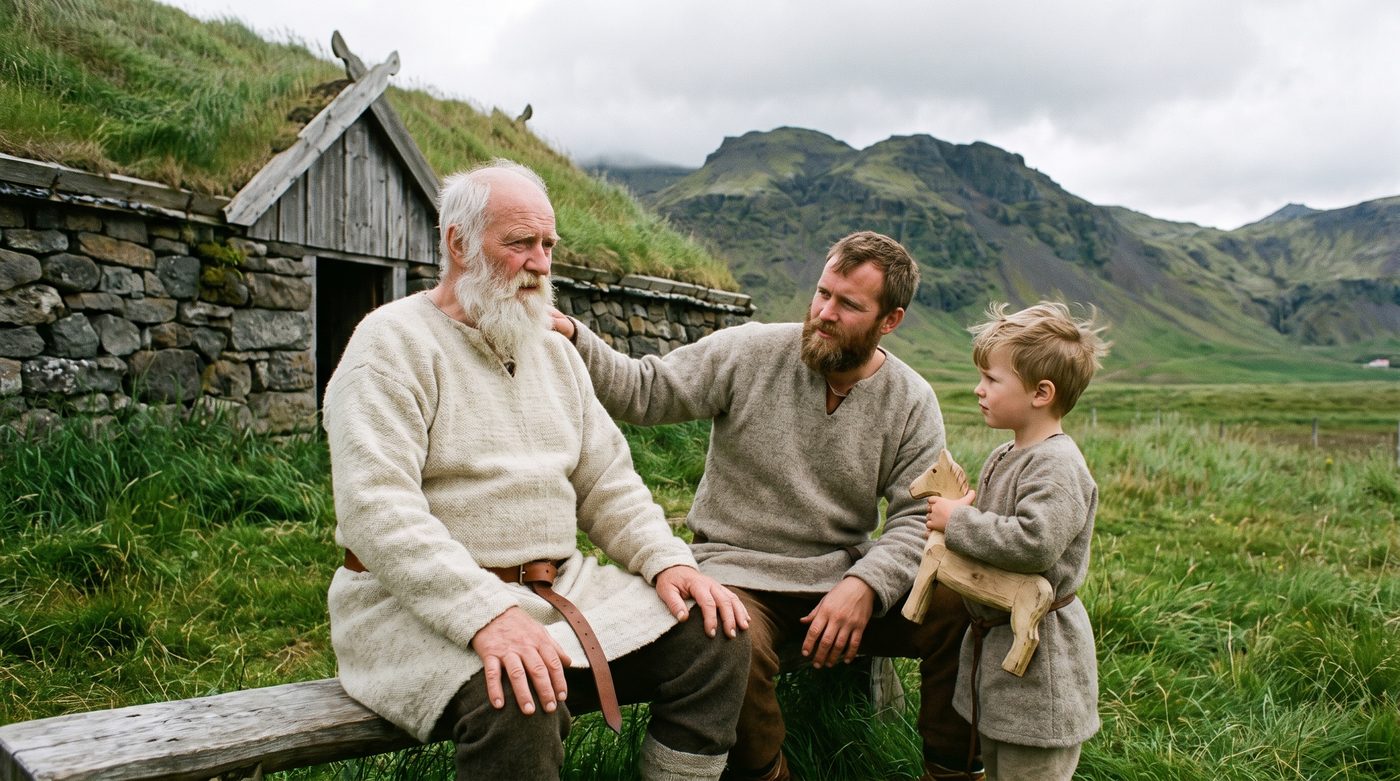
Every name below is recorded in a named medieval source. The full list, with the elements broken out, is in Viking male names.
| Name | Meaning | Attested in |
|---|---|---|
| Óláfr | ancestor's descendant | Landnámabók |
| Þórsteinn | Þórr's stone | Landnámabók |
| Þórgeirr | Þórr's spear | Landnámabók |
| Þórvaldr | Þórr's ruler | Landnámabók |
| Þórbjörn | Þórr's bear | Landnámabók |
| Þórfinnr | Þórr's Finn | Landnámabók |
| Þórgrímr | Þórr's mask | Landnámabók |
| Þórkell | Þórr's helmet | Landnámabók |
| Þóroddr | Þórr's spear-point | Landnámabók |
| Þórarinn | Þórr's hearth | Landnámabók |
| Þórir | of Þórr | Landnámabók |
| Björn | bear | Landnámabók |
| Sigurðr | victory-guardian | Völsunga saga |
| Haraldr | army-ruler | Heimskringla |
| Hákon | high son | Heimskringla |
| Eiríkr | ever-ruler | Heimskringla |
| Ívarr | yew-warrior | Heimskringla |
| Ketill | helmet, cauldron | Landnámabók |
| Grímr | mask, helm | Landnámabók |
| Gunnarr | battle-warrior | Njáls saga |
| Egill | edge, blade | Egils saga |
| Njáll | champion (Gaelic loan) | Njáls saga |
| Kári | curly-haired; squall | Njáls saga |
| Skarphéðinn | sharp fur-cloak | Njáls saga |
| Höskuldr | grey-haired | Laxdæla saga |
| Hrútr | ram | Njáls saga |
| Flosi | chieftain | Njáls saga |
| Ásgrímr | god-mask | Njáls saga |
| Snorri | attack, onslaught | Eyrbyggja saga |
| Arnkell | eagle-helmet | Eyrbyggja saga |
| Steinþórr | stone-Þórr | Eyrbyggja saga |
| Illugi | of ill mind | Grettis saga |
| Ásmundr | god-protection | Grettis saga |
| Grettir | the snarler | Grettis saga |
229 more attested names are in the name generator, each with its meaning and source.

Attested Viking Women's Names
Expanded, with the endings explained, in Viking female names.
| Name | Meaning | Attested in |
|---|---|---|
| Guðrún | god's secret lore | Laxdæla saga |
| Auðr | wealth, fortune | Laxdæla saga |
| Unnr | wave; love | Laxdæla saga |
| Helga | holy, consecrated | Gunnlaugs saga ormstungu |
| Þórdís | Þórr's lady | Landnámabók |
| Þórgunna | Þórr's battle | Eyrbyggja saga |
| Þórhildr | Þórr's battle | Njáls saga |
| Þórunn | Þórr's love | Landnámabók |
| Þóra | of Þórr | Landnámabók |
| Ásdís | god-lady | Grettis saga |
| Ásgerðr | god-protection | Egils saga |
| Áslaug | god-consecrated | Ragnars saga loðbrókar |
| Bergþóra | helping Þórr | Njáls saga |
| Bergljót | protected beauty | Heimskringla |
| Björg | help, rescue | Landnámabók |
| Droplaug | dew-consecrated | Droplaugarsona saga |
| Freydís | Freyja's lady | Grœnlendinga saga |
| Gró | to grow | Landnámabók |
| Gunnhildr | battle-battle | Heimskringla |
| Hallgerðr | rock-protection | Njáls saga |
| Hallbera | rock she-bear | Landnámabók |
| Hallveig | rock-strength | Landnámabók |
| Herdís | army-lady | Landnámabók |
| Hildigunnr | battle-battle | Njáls saga |
| Hildr | battle | Poetic Edda |
| Ingibjörg | Ing's help | Landnámabók |
| Ingigerðr | Ing's protection | Heimskringla |
| Jófríðr | horse-fair | Gunnlaugs saga ormstungu |
129 more attested names are in the name generator, each with its meaning and source.

Bynames: the Part Most Guides Skip
This is where Norse naming has its character, and it is almost always missing from name lists. Bynames were blunt, public and not chosen by the bearer.
| Byname | Meaning | Borne by | Attested in |
|---|---|---|---|
| hárfagri | fine-hair, fair-hair | Haraldr hárfagri | Heimskringla |
| blóðøx | blood-axe | Eiríkr blóðøx | Heimskringla |
| loðbrók | shaggy-breeches | Ragnarr loðbrók | Ragnars saga loðbrókar |
| flatnefr | flat-nose | Ketill flatnefr | Landnámabók |
| tréfótr | wooden-leg | Önundr tréfótr | Grettis saga |
| tjúguskegg | fork-beard | Sveinn tjúguskegg | Heimskringla |
| silkiskegg | silk-beard | Sigtryggr silkiskegg | Njáls saga |
| járnsíða | iron-side | Björn járnsíða | Ragnars saga loðbrókar |
| berfœttr | bare-foot | Magnús berfœttr | Heimskringla |
| harðráði | hard-ruler, stern in counsel | Haraldr harðráði | Heimskringla |
| inn digri | the stout | Óláfr inn digri | Heimskringla |
| inn kyrri | the quiet | Óláfr inn kyrri | Heimskringla |
| inn helgi | the holy | Óláfr inn helgi | Heimskringla |
| inn góði | the good | Magnús inn góði | Heimskringla |
| inn rauði | the red | Eiríkr inn rauði | Landnámabók |
| inn svarti | the black | Hallr inn svarti | Landnámabók |
| inn hvíti | the white | Óláfr inn hvíti | Landnámabók |
| inn gamli | the old | Ketill inn gamli | Landnámabók |
| inn ungi | the young | Þórðr inn ungi | Landnámabók |
| inn sterki | the strong | Ormr inn sterki | Landnámabók |
| inn spaki | the wise | Ari inn spaki | Íslendingabók |
| inn auðgi | the wealthy | Þorsteinn inn auðgi | Landnámabók |
| inn snjalli | the valiant, the eloquent | Hrœrekr inn snjalli | Heimskringla |
| inn prúði | the magnificent | Ólafr inn prúði | Laxdæla saga |
75 more attested bynames are in the name generator.
Grammatical Gender Is Not Optional
Old Norse names and their bynames agree in gender. A man is inn gamli, the old. A woman is in gamla. Ketill inn djúpúðgi and Auðr in djúpúðga carry the same byname in two forms. Any list or generator that ignores this is producing something that is not Old Norse.
Specialist Lists
For narrower questions, these go deeper than this guide can:
Valkyrie names, translated, from Grímnismál and the Prose Edda. Norse names that mean warrior, with the real Norse words for a fighting man. Viking clan names, and why the Norse had no clans. Norse names for dogs and cats, including the named animals of myth. Nord names, and which parts of the fantasy are real.

Viking Names Still in Use
| Modern form | Old Norse | Meaning |
|---|---|---|
| Erik, Eric | Eiríkr | ever-ruler |
| Olaf, Olav | Óláfr | ancestor's descendant |
| Bjorn | Björn | bear |
| Gunnar | Gunnarr | battle-warrior |
| Harald | Haraldr | army-ruler |
| Magnus | Magnús | great |
| Sven, Svein | Sveinn | boy, young man |
| Ingrid | Ingiríðr | Ing's beauty |
| Astrid | Ástríðr | god-fair |
| Sigrid | Sigríðr | victory-rider |
| Helga | Helga | holy, consecrated |
| Thora, Tora | Þóra | of the god Þórr |
Get Your Own
Our Viking name generator assembles a full name from this same data, shows the meaning and the source for every part, writes it in Younger Futhark and gives you a card to share. If you want any other word in runes, use the rune translator, and we engrave names on hand-forged blades.
Frequently Asked Questions
What were Viking names like?
A Viking had a given name and usually a byname, and no surname. The given name was normally a compound of two meaningful elements, such as Þórsteinn, the god Þórr plus stone. The byname was a descriptive nickname others attached to you.
Did Vikings have surnames?
No. They used a patronymic, which names your father rather than your family, so it changed every generation and differed between a brother and a sister.
What is the most common Viking name?
Names built on the Þór- element dominate the record. Þórsteinn, Þórgeirr, Þórbjörn, Þórkell and Þórðr together account for a large share of the men named in Landnámabók.
Are Viking names still used today?
Many never stopped. Erik, Olaf, Bjorn, Gunnar, Harald, Magnus, Ingrid, Astrid, Sigrid, Helga and Thora all descend directly from Viking Age names.
Where do we know Viking names from?
From runestones, from the Icelandic Landnámabók, from Snorri's Heimskringla, from the family sagas and from Sturlunga. Every name in this guide is shown with the source it appears in.
What is a good Viking name for a baby?
The ones with clear, pleasant meanings and easy modern spellings travel best: Astrid (god-fair), Ingrid (Ing's beauty), Erik (ever-ruler), Bjorn (bear), Sigrid (victory-rider) and Helga (holy).